Vitamin B12 for Anxiety & Mood: What the Science Says
Key Takeaways
B12 plays a direct role in producing serotonin, dopamine, and other neurotransmitters that regulate mood, anxiety, and stress resilience.
Genuine B12 deficiency can contribute to anxiety-like symptoms, irritability, low mood, and a "wired but tired" feeling — and correcting it can meaningfully improve how you feel.
B12 is not a standalone treatment for anxiety or depression. It works best as one biological variable within a broader strategy that includes therapy, sleep, exercise, and — where appropriate — medication.
Building Blocks includes methylcobalamin so this simple, fixable factor isn't quietly working against your mental health while you address the bigger picture.
This article is educational and does not replace professional mental health care. If you're experiencing significant anxiety, depression, or mood changes that are affecting your daily life, please work with a qualified mental health professional or your healthcare provider.
Why People Blame Their Anxiety on B12 (and Why That's Partly Right)
Constant worry. Racing thoughts at 2 a.m. A low mood that doesn't lift despite doing "all the right things." You start searching for answers, and somewhere between the medical websites and the social media posts, you land on B12 deficiency as a possible explanation.
There's a real grain of truth here. B12 deficiency can cause mood changes, irritability, heightened anxiety, and depressive symptoms — these are documented, clinically recognized consequences of insufficient B12. (For a full overview of vitamin B12 benefits beyond mood, start with our master guide.) When the brain doesn't have the raw materials it needs to produce neurotransmitters and maintain healthy nerve function, mood is one of the first things to shift.
Where it gets more complicated is that anxiety and mood disorders are almost always multi-factorial. Genetics, life circumstances, trauma history, sleep quality, hormonal status, physical health, and social support all play roles. B12 is rarely the single cause of someone's anxiety. But it can be a contributing factor that amplifies everything else — and unlike many of those other variables, it's straightforward to identify and correct.
The practical question isn't "is B12 the reason I'm anxious?" It's "is low B12 making my anxiety worse than it needs to be?" For a lot of people, the answer is yes.
How Vitamin B12 Affects Brain Chemistry and Stress Systems
Neurotransmitter production
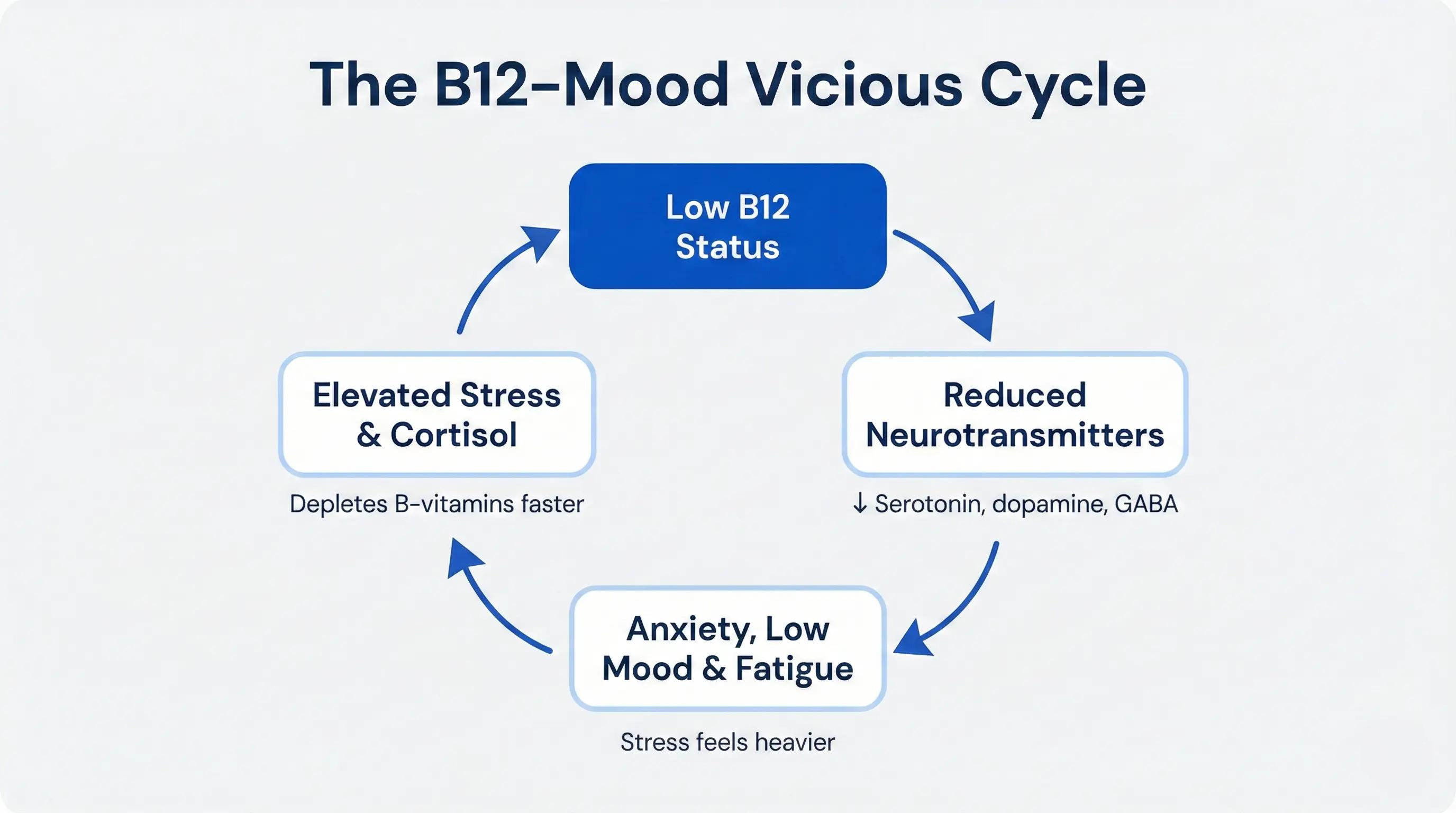
B12, together with folate and B6, is essential for the methylation reactions that produce serotonin, dopamine, norepinephrine, and GABA — the neurotransmitters most directly involved in regulating mood, motivation, calm, and emotional stability. When B12 is insufficient, these pathways slow down. The brain doesn't stop making neurotransmitters entirely, but the output is reduced, and the balance shifts in ways that can show up as anxiety, low mood, or both simultaneously.
This is the biological mechanism behind the clinical observation that B12-deficient patients frequently present with psychiatric symptoms. It's not a vague "wellness" connection — it's a documented biochemical dependency. Your brain needs B12 to make the molecules that keep you emotionally regulated.
Homocysteine, inflammation, and the brain
When B12 is low, homocysteine accumulates. Beyond its association with vascular risk and cognitive decline (which we cover in our B12 for memory and brain health guide), elevated homocysteine has been linked to neuroinflammation and oxidative stress in brain tissue — both of which are implicated in mood disorders. Some research suggests that the inflammatory cascade triggered by chronically elevated homocysteine may lower the threshold for anxiety and depressive episodes in susceptible individuals.
Keeping homocysteine in a healthy range through adequate B12, folate, and B6 doesn't guarantee you won't experience mood problems. But it removes one biochemical stressor that can make existing vulnerabilities worse.
Nervous system and stress tolerance
B12 deficiency doesn't just affect mood directly — it degrades your capacity to handle stress. Fatigue from impaired red blood cell production, disrupted sleep from nervous system dysfunction, and the cognitive fog from demyelination all compound to reduce your stress tolerance. When your baseline is already depleted, normal stressors feel disproportionately heavy.
This interacts with the HPA axis — your body's central stress-response system — in a straightforward way: when you're physically exhausted and neurologically compromised, cortisol stays elevated longer, recovery from stressful events takes more time, and the subjective experience of stress intensifies. It's not that B12 deficiency causes your stress. It's that it strips away your ability to manage it effectively.
For another key nutrient in this space, see our guide on magnesium for anxiety and stress, which covers the GABA and parasympathetic pathways that complement what B12 does on the neurotransmitter side.
Symptoms of Low B12 That Can Look Like Anxiety or Depression
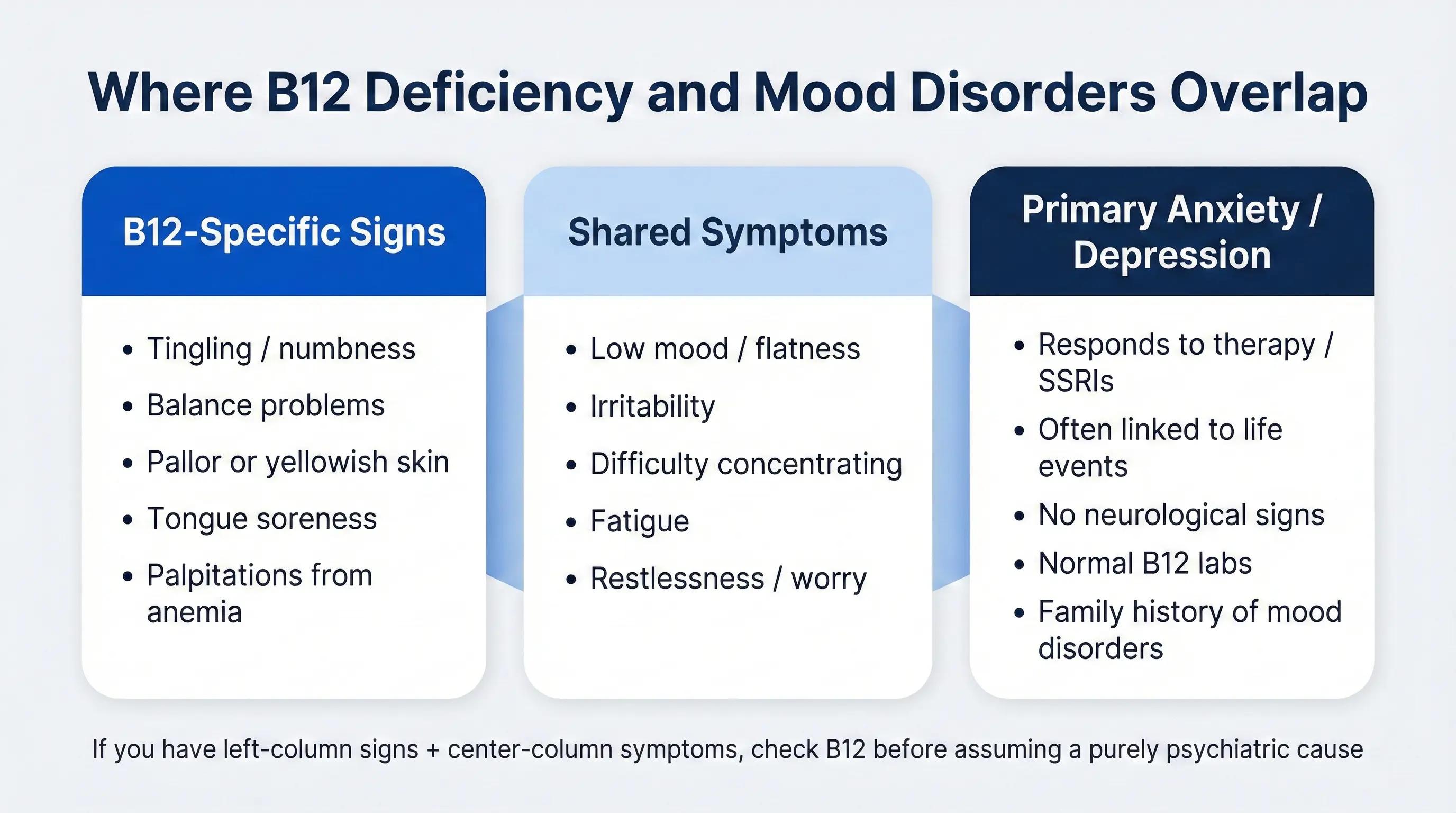
One of the challenges with B12 deficiency is that its mood symptoms overlap heavily with primary anxiety and depressive disorders. This creates a real risk of misattribution — treating the symptoms psychiatrically while the underlying nutritional driver goes unaddressed.
Mood-related symptoms of B12 deficiency include persistent irritability, low mood or emotional flatness that doesn't respond to typical coping strategies, restlessness, difficulty concentrating, and a general sense of being "off" that's hard to articulate. Physical symptoms can compound the picture: palpitations and shortness of breath from anemia sometimes feel indistinguishable from panic attacks. Fatigue and brain fog erode motivation and engagement in ways that mimic depression.
The distinguishing feature is usually that B12-related mood symptoms don't appear in isolation. If anxiety or low mood is accompanied by unusual fatigue, tingling or numbness, pallor, tongue changes, or cognitive difficulties, B12 deserves a place on the differential.
The risk groups remain consistent: people eating plant-based or low-meat diets, adults over 50, long-term users of metformin or proton pump inhibitors, anyone with GI absorption issues, people on GLP-1 protocols with significantly reduced food intake, and heavy alcohol users.
If you recognize this picture, lab work is the next step — not self-diagnosis and not a supplement shopping spree. Serum B12, and potentially methylmalonic acid (MMA) and homocysteine, give your clinician the data to determine whether B12 is a contributing factor or whether the mood symptoms are being driven by something else entirely.
What the Research Shows: Can B12 Help Anxiety and Depression?
The evidence breaks down along predictable lines, and being clear about what each tier shows is important.
In people with documented B12 deficiency, the association with depressive symptoms and anxiety is strong and well replicated. Multiple observational studies have found that individuals with low B12 are significantly more likely to report depressive symptoms, and intervention studies show that correcting the deficiency improves mood outcomes — sometimes substantially. A subset of clinical research has also demonstrated that adding B12 (and other B-vitamins) to existing antidepressant regimens can improve response rates compared to antidepressants alone, particularly when baseline B12 was suboptimal.
In people whose B12 is already in the normal range, the data is more modest. Supplementing with additional B12 in this population has not been consistently shown to produce meaningful improvements in anxiety or mood on its own. Some studies report subtle benefits as part of multi-nutrient interventions (B12 + folate + B6 + D), but the effect sizes are small and the contributions of individual nutrients are hard to isolate.
The balanced conclusion: optimizing B12 is a high-upside, low-risk move for anyone with low or low-normal levels and mood symptoms. For people already in the optimal range, B12 alone isn't going to resolve an anxiety disorder or replace therapy. But maintaining solid B12 status ensures that one easily correctable biological variable isn't quietly undermining your mental health.
When It Makes Sense to Check Your B12 for Anxiety and Mood
Not every person with anxiety needs a B12 test. But several situations make it especially reasonable.
Testing is worth pursuing if you're experiencing new or worsening mood symptoms and have one or more risk factors for B12 deficiency. It's particularly warranted if mood symptoms are accompanied by neurological signs (numbness, tingling, balance issues) or anemia symptoms (fatigue, pallor, shortness of breath). Anyone on long-term metformin, PPIs, or a GLP-1 protocol with significantly reduced intake for months should have B12 checked as part of routine monitoring. And if you've been eating a plant-based diet for an extended period without supplementation, testing is overdue.
Standard lab work starts with serum B12. If the result is borderline or your symptoms are suggestive despite a "normal" number, MMA and homocysteine add diagnostic sensitivity. Your provider can interpret these in the context of your full clinical picture.
One important note: changes to psychiatric medications or therapy plans should always be guided by a mental health professional. Discovering that low B12 is contributing to your mood doesn't mean you should adjust medications on your own. It means you have additional information to share with your care team.
Using Vitamin B12 as Part of an Anxiety and Mood Strategy
Form and dose for mood support
Methylcobalamin is the preferred form for daily mood-supportive supplementation. As the active methyl donor form of B12, it participates directly in the neurotransmitter synthesis pathways that matter most for mood regulation. Dose and route depend on the severity of any deficiency and your absorption profile — your clinician can guide repletion if needed, while a well-formulated daily supplement handles maintenance.
Stacking B12 with other evidence-based tools
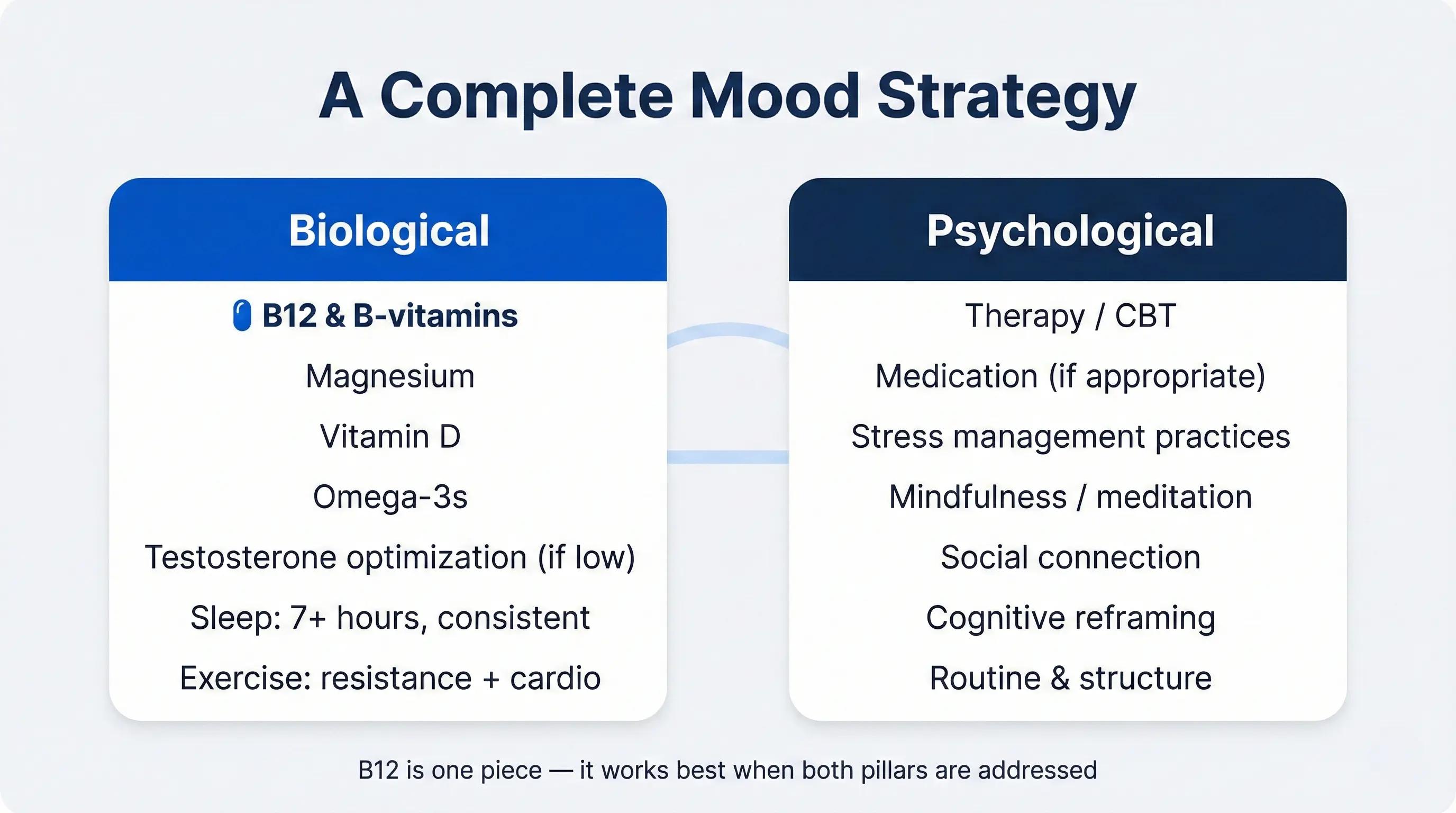
B12 is most effective as one component within a broader mood strategy. The tools with the strongest evidence for anxiety and mood support include consistent sleep (seven-plus hours, regular schedule), regular physical activity (both resistance training and cardiovascular exercise have demonstrated antidepressant and anxiolytic effects), therapy or coaching for cognitive and behavioral patterns, mindfulness or stress-management practices, and social connection.
On the nutritional side, magnesium supports GABA activity and parasympathetic nervous system function. Vitamin D deficiency has been linked to mood disorders independently. Omega-3 fatty acids have modest but consistent evidence for supporting mood. And for men experiencing mood changes alongside declining energy, libido, or motivation, optimizing testosterone can address a hormonal contributor that no amount of B12 will fix.
For stress that's specifically affecting sleep quality or emotional regulation, Maximus' oxytocin calming cream offers a non-sedating, non-habit-forming option that complements the nutritional foundation.
How Maximus uses B12 in context
Our philosophy is to combine psychological tools with biological ones. Building Blocks ensures that B12 and other foundational nutrients — folate, B6, magnesium, vitamin D — are handled consistently, so your brain chemistry isn't fighting an unnecessary uphill battle. From there, you and your clinician address therapy, medication (if appropriate), lifestyle, and the Maximus protocols that support your broader health. The foundation has to be solid for everything built on top of it to work.
Who Should Be Cautious or Talk to a Clinician First
While B12 supplementation at standard doses is safe for most people, certain situations call for extra care and professional guidance.
If you're currently on psychiatric medication — antidepressants, anxiolytics, mood stabilizers — don't adjust your treatment plan based on B12 results without involving your prescriber. B12 optimization may complement your existing regimen, but it doesn't replace it, and changes should be coordinated. Individuals with a history of bipolar disorder should approach any intervention described as "energizing" or "mood-enhancing" with caution and clinician oversight. And anyone managing complex medical conditions or taking multiple medications should discuss new supplements with their healthcare provider to rule out interactions.
The goal is integration, not substitution. B12 fits into your care plan — it doesn't replace the other pieces.
One Variable Worth Checking
B12 won't cure an anxiety disorder. It won't replace therapy, medication, or the lifestyle investments — sleep, exercise, relationships — that drive long-term mental health. But for something so easy to overlook, so simple to test, and so straightforward to fix, it's remarkable how much of a difference correcting a deficiency can make.
If you're in a risk group and experiencing mood symptoms alongside fatigue, brain fog, or neurological changes, getting your B12 checked might be the single most actionable step available to you right now. And if your levels are already solid, maintaining them through Building Blocks keeps one more biological variable from working against you — so the strategies that matter most for your mental health can work the way they're supposed to.
Vitamin B12 for Anxiety & Mood — FAQs
How long does it take for B12 to affect mood?
For people correcting a genuine deficiency, subtle mood improvements often begin within two to four weeks, with more noticeable changes developing over one to three months as neurotransmitter production normalizes and overall energy improves. If your deficiency has been long-standing, full mood recovery may take longer and often depends on addressing other contributing factors (sleep, stress, hormones) in parallel. B12 isn't a fast-acting anxiolytic — it's a slow rebuild of the biochemical infrastructure that supports emotional regulation.
Can I stop my anxiety medication if I start taking B12?
No — and this is important. Never discontinue or reduce psychiatric medication based on a supplement change without guidance from your prescriber. Even if low B12 was contributing to your symptoms, medication adjustments need to be managed by a professional who can monitor your response and taper appropriately if that becomes the right move. B12 may complement your treatment plan, but it doesn't replace it.
What is the best time of day to take B12 for anxiety?
Morning or early afternoon is generally preferred, since B12 supports energy metabolism and alertness. Taking it late in the evening could theoretically interfere with sleep onset in some individuals, though evidence on this is limited. The more important factor is consistency — taking it daily at roughly the same time, ideally with a meal, matters more than optimizing the exact hour. If you're taking it as part of a multivitamin like Building Blocks, morning with breakfast is the simplest approach.
Can too much B12 worsen anxiety?
This is uncommon but occasionally reported anecdotally, particularly at very high doses. Some individuals — especially those sensitive to changes in methylation activity — describe feeling overstimulated or jittery with high-dose methyl B12. If you notice increased anxiety after starting B12 supplementation, it's worth discussing with your provider. Reducing the dose or switching forms may help. For most people taking B12 at standard supplemental doses as part of a well-formulated multivitamin, this isn't a concern. For stress and sleep that need attention alongside mood, our guides on magnesium for anxiety and magnesium and sleep cover complementary strategies.