Vitamin B12: Benefits, Deficiency Signs, and Best Forms
Key Takeaways
B12 is essential for energy production, nerve function, red blood cells, and DNA synthesis — it's foundational infrastructure, not a stimulant.
Deficiency is more common than most people realize, especially in vegetarians, older adults, people on metformin or PPIs, and those on GLP-1 medications with reduced food intake.
Early signs include fatigue, brain fog, and low mood. Left unchecked, deficiency can progress to numbness, balance problems, and irreversible nerve damage.
Methylcobalamin — the form used in Building Blocks — mirrors the body's active B12 and is well suited for long-term daily use.
Optimizing B12 isn't about megadosing. It's about identifying genuine gaps, choosing the right form, and building it into a consistent daily regimen.
What Is Vitamin B12 and What Does It Actually Do?
Vitamin B12 (also called cobalamin) is a water-soluble vitamin that your body can't make on its own. You either get it from food, supplementation, or you run low — and running low has consequences that reach far beyond fatigue.
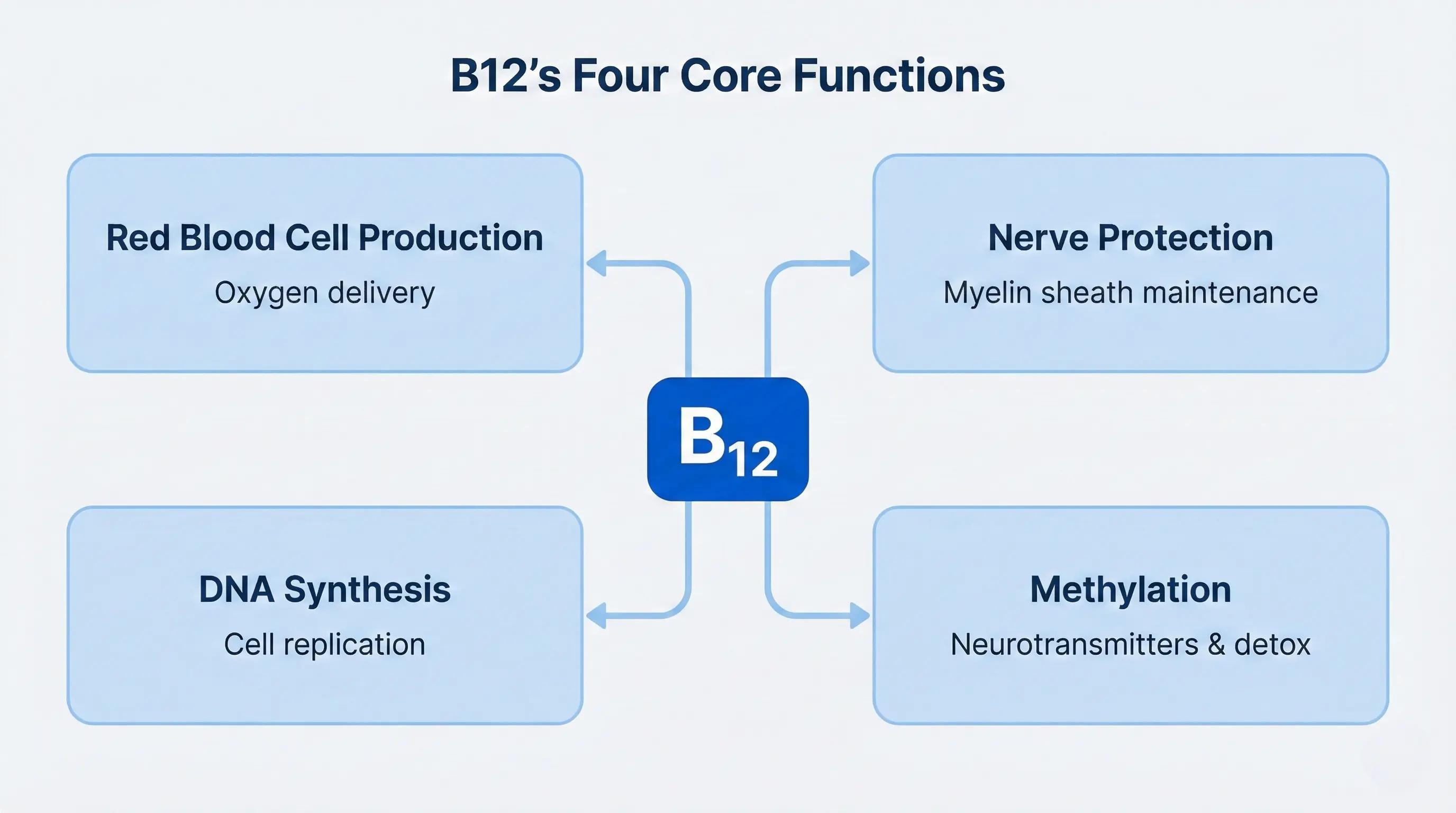
B12 has four core jobs in the body. It helps produce red blood cells, which carry oxygen to every tissue and muscle you have. It maintains the myelin sheath that insulates your nerves, keeping signals fast and accurate. It's required for DNA synthesis, which means every cell in your body depends on it for replication. And it drives methylation — a biochemical process that regulates everything from homocysteine clearance to neurotransmitter production (serotonin, dopamine, and more).
In short, B12 is foundational infrastructure. It doesn't give you a buzz or a spike. It allows your cells, nerves, and brain to do their jobs properly.
The challenge is that B12 is found almost exclusively in animal-sourced foods: meat, fish, eggs, and dairy. If you're eating a plant-based or plant-heavy diet, your intake may be inadequate without supplementation. And even if your diet is solid, absorption problems can still leave you short.
How Vitamin B12 Powers Energy, Brain, and Hormone Health
Energy and red blood cells
One of the most searched questions about B12 is whether it actually boosts energy. The honest answer: it depends entirely on your status.
B12 plays a direct role in how your body converts food into usable energy (ATP). It's also essential for producing healthy red blood cells. When B12 is low, red blood cells become abnormally large and inefficient — a condition called megaloblastic anemia — which means less oxygen reaching your muscles, brain, and organs. The result is fatigue that no amount of caffeine will fix.
If you're deficient, correcting B12 can feel like flipping a switch. If your levels are already adequate, megadosing won't give you a noticeable boost. B12 isn't a stimulant. It's the infrastructure that lets your mitochondria function. There's a difference.
Nervous system and cognition
B12 is critical for maintaining myelin, the protective coating around your nerve fibers. Think of myelin like insulation on electrical wiring. When it degrades, signals slow down, misfire, or stop reaching their destination entirely. That's why B12 deficiency often shows up as numbness or tingling in the hands and feet, difficulty with balance, and persistent brain fog.
B12 also helps regulate homocysteine, an amino acid that's been linked to cardiovascular risk and cognitive decline when levels run too high. Adequate B12 — along with folate and B6 — keeps homocysteine in check, supporting both vascular and brain health over the long term.
Methylation, mood, and hormones
Methylation is one of those processes most people don't think about until it goes wrong. It's involved in producing neurotransmitters like serotonin and dopamine, processing hormones, repairing DNA, and detoxifying certain compounds. B12, specifically methylcobalamin, is one of the key drivers of the methylation cycle.
When methylation is compromised — whether from low B12, genetic variants like MTHFR, or chronic stress — you may notice shifts in mood, stress tolerance, and cognitive clarity. This is why B12 status is relevant not just for energy, but for emotional resilience and overall neurological performance. (For another key nutrient in this space, see our guide on magnesium for anxiety and stress.)
Why this matters for performance and protocol optimization
If you're pushing your body through training, managing hormones through a testosterone protocol, or on a GLP-1 weight loss protocol where appetite is suppressed and food intake is lower, B12 isn't optional — it's a prerequisite. Red blood cell production, oxygen delivery, nerve signaling, and neurotransmitter synthesis all depend on having enough of it. Letting B12 slide while investing in advanced protocols is like running premium fuel through a car with a clogged filter.
Vitamin B12 Deficiency: Who's at Risk and What It Looks Like
Why deficiency is more common than people think
B12 absorption is surprisingly complex. Unlike most water-soluble vitamins, B12 requires stomach acid to separate it from food, a protein called intrinsic factor to carry it, and a healthy ileum (the end of the small intestine) to absorb it. If any step in that chain is impaired, deficiency develops — even if your diet looks fine on paper.
The groups at highest risk include:
Vegans and vegetarians, or anyone eating very little meat, fish, eggs, or dairy.
Adults over 50, who often produce less stomach acid and intrinsic factor.
People taking metformin for blood sugar management, which is known to reduce B12 absorption over time.
Long-term users of proton pump inhibitors (PPIs) or H2 blockers for acid reflux.
Anyone who's had bariatric surgery or has a GI condition affecting the small intestine (celiac, Crohn's).
Heavy alcohol users, whose GI function and liver metabolism are both impaired.
People on GLP-1 medications whose appetite suppression has significantly reduced overall food intake for extended periods.
What deficiency actually looks like
B12 deficiency doesn't always announce itself with a dramatic symptom. It often builds slowly, and the early signs are easy to dismiss as stress, aging, or overtraining.
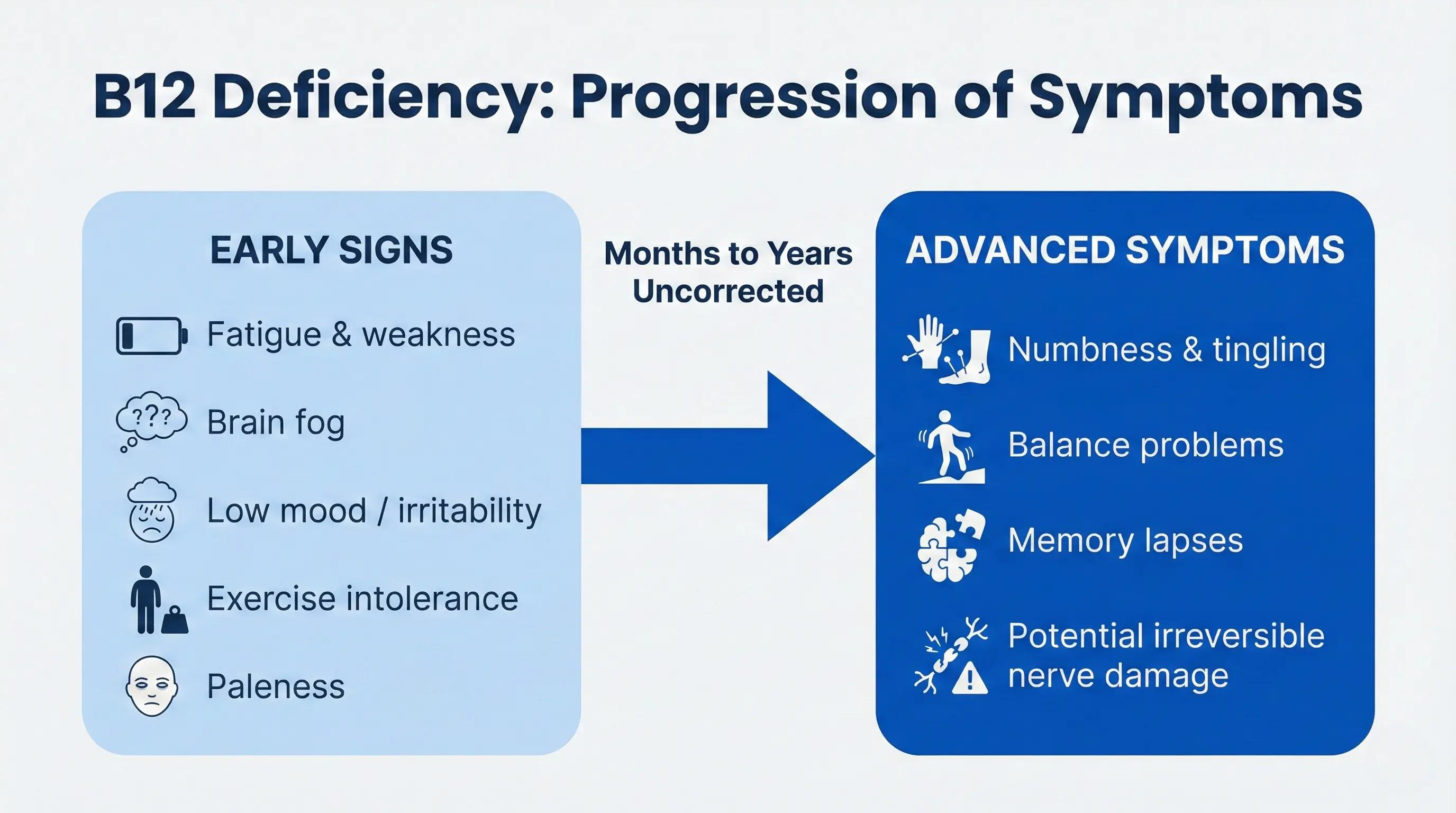
Early warning signs tend to include persistent fatigue and weakness, brain fog and difficulty concentrating, low mood or irritability, paleness, and exercise intolerance — the sense that your workouts are harder than they should be for no clear reason.
If deficiency is left uncorrected over months or years, more serious neurological symptoms can develop: numbness or tingling in the hands and feet, problems with balance and coordination, memory lapses, and tongue soreness. What makes this especially important is that some neurological damage from prolonged B12 deficiency can be irreversible, even after levels are restored. Early identification matters.
Labs and diagnosis
The standard test is a serum B12 level, but it has limitations. You can fall in the "normal" range and still be functionally deficient. More sensitive markers include methylmalonic acid (MMA) and homocysteine — both rise when B12 activity is insufficient at the cellular level. If you're experiencing symptoms and your serum B12 is borderline, ask your clinician about these additional markers.
This is educational information, not a diagnosis. If any of these symptoms resonate, work with a healthcare provider who can interpret your labs in the context of your history, medications, and goals.
Forms of Vitamin B12: Methylcobalamin vs. Cyanocobalamin and More
Not all B12 is the same. The form you take matters for how efficiently your body can use it — and the differences are worth understanding.
The four forms you'll encounter are methylcobalamin (active methyl form your body uses directly), adenosylcobalamin (the other active coenzyme form, involved in mitochondrial energy), hydroxocobalamin (a natural form often used in injections with a longer half-life), and cyanocobalamin (a synthetic form widely used in cheap supplements and fortified foods).
Methylcobalamin vs. cyanocobalamin
Cyanocobalamin is the most common form in budget supplements because it's cheap and stable. Your body can convert it into active forms, but it has to do extra work to get there — stripping off a cyanide molecule (in trace amounts, not dangerous) and then converting it through methylation pathways. For most healthy people, this works adequately.
Methylcobalamin skips that conversion step. It's already in the active methyl form your body uses for methylation, neurotransmitter synthesis, and homocysteine metabolism. For people with methylation concerns (including those with MTHFR gene variants), long-term daily supplementation, or anyone who wants a more direct pathway to usable B12, methylcobalamin is generally the stronger choice.
The nuanced verdict: cyanocobalamin isn't harmful and has plenty of clinical data behind it, especially in injection form. But for a daily supplement designed to support ongoing performance and methylation, methylcobalamin is preferred — and that's why it's the form we use in Building Blocks.
B12 injections vs. oral supplements
B12 injections have a reputation as "energy shots," but the clinical reality is more specific. Injections are indicated when there's confirmed severe deficiency, pernicious anemia (an autoimmune condition where intrinsic factor is absent), or documented malabsorption that prevents oral B12 from reaching adequate levels.
For the vast majority of people with dietary gaps, mild deficiency, or simply wanting to maintain optimal status, high-dose oral or sublingual B12 is effective. Studies have shown that even in people with absorption issues, high oral doses can achieve sufficient levels through passive diffusion — a secondary absorption pathway that doesn't require intrinsic factor.
If your levels are already normal, an injection won't give you a noticeable energy spike. B12 doesn't work like caffeine. It's substrate, not stimulant. Save the injections for situations where your clinician confirms they're necessary.
How Much Vitamin B12 Do You Need?
The recommended dietary allowance (RDA) for B12 is 2.4 mcg per day for adults. That number is designed to prevent clinical deficiency in the general population. It's not an optimization target.
Most performance-oriented clinicians recommend daily intakes well above the RDA, particularly for people supplementing to cover dietary gaps or address suboptimal lab values. Common daily supplement doses range from 500 to 2,500 mcg, depending on form, individual absorption, and clinical context. B12 is water-soluble with an excellent safety profile — your body excretes what it doesn't need — but that doesn't mean more is automatically better. At a certain point, additional B12 provides diminishing returns if your stores are already replete.
For healthy omnivores eating a varied diet rich in animal protein, dietary B12 combined with a well-formulated daily supplement is usually sufficient. For vegetarians, vegans, and anyone on medications that impair absorption (metformin, PPIs), supplementation isn't a nice-to-have — it's essential.
Building Blocks provides methylcobalamin at a dose designed for consistent daily support alongside other B-vitamins and methylation cofactors. It's calibrated to maintain optimal status as part of a broader protocol — not to replace medical repletion if your levels are critically low.
If you have confirmed deficiency, follow your provider's repletion protocol first. Once your levels are restored, a daily maintenance dose through your supplement regimen keeps you there.
Who Benefits Most from Optimizing B12?
Men on testosterone protocols
If you're on a testosterone optimization protocol and training hard, B12 is directly relevant. It supports red blood cell production — which matters for oxygen delivery and exercise capacity — and contributes to the energy metabolism and mood stability that make high training volumes sustainable. Letting B12 slip while dialing in your hormones is an unnecessary gap in the foundation.
GLP-1 users and people in aggressive fat-loss phases
Appetite suppression is the mechanism that makes GLP-1 medications effective for weight loss. But eating less also means fewer micronutrients coming in. B12 is one of the first to fall short, especially if you're already on the edge of adequacy. Fatigue on a GLP-1 protocol isn't always about calories — sometimes it's about the nutrients you're no longer getting enough of. A clinically-dosed daily multivitamin acts as a micronutrient safety net during extended periods of reduced intake.
Plant-based eaters
If you follow a vegan or vegetarian diet, B12 supplementation is non-negotiable for long-term health. There are no reliable plant-based food sources of B12, and stores can take years to deplete — which means deficiency often develops silently. By the time symptoms show up, you may already have significant depletion.
High performers with demanding schedules
You don't need a clinical diagnosis to benefit from optimizing your B12 status. Chronic stress, inconsistent meals, heavy travel, and high cognitive demands all increase your body's turnover of B-vitamins. Before chasing exotic biohacks or niche supplements, make sure the fundamentals are covered. B12 is one of them.
This is exactly why we built methylcobalamin directly into Building Blocks, our prescription-strength multivitamin designed to sit underneath testosterone, GLP-1, and other Maximus protocols as a foundational micronutrient base.
How to Choose a Vitamin B12 Supplement
If you're evaluating B12 supplements — whether standalone or as part of a multivitamin — here's what actually matters:
The form should be methylcobalamin (or a blend of active forms including adenosylcobalamin). This gives your body the most direct pathway to usable B12 without relying on extra conversion steps. The dose should be appropriate for daily maintenance, not just meeting the bare-minimum RDA. For most people supplementing proactively, that means somewhere in the hundreds-to-low-thousands of micrograms per day. Delivery format — capsule, sublingual tablet, or liquid — matters less than form and dose, though sublingual delivery may offer a slight advantage for people with GI absorption concerns.
Look for third-party testing, minimal unnecessary fillers, and transparent labeling. If a supplement doesn't tell you which form of B12 it uses, that's usually because it's the cheapest one available.
Building Blocks uses methylcobalamin alongside other active B-vitamins and methylation cofactors (including folate as methylfolate), dosed for daily performance support rather than one-time repletion. It's designed to complement the protocols you're already on — not to replace them, and not to be another bottle collecting dust on your shelf.
If you're experiencing persistent fatigue, neurological symptoms, GI conditions, or following a long-term restrictive diet, bring it up with your clinician. Some situations call for testing and targeted repletion before switching to maintenance-level supplementation.
What B12 Comes Down To
B12 isn't glamorous, and it doesn't make headlines the way testosterone, GLP-1s, or growth hormone do. But it's one of those foundational nutrients where a gap quietly undermines everything else you're investing in — energy, training capacity, cognitive performance, mood, and recovery.
The practical takeaway: know your status, correct genuine deficiency with your clinician's guidance, and maintain optimal levels with a supplement that uses active forms at meaningful doses. Don't chase megadose B12 energy shots if your levels are fine. Don't ignore symptoms because they seem too vague to matter. Optimize the infrastructure first, then layer on the advanced protocols. That's the approach behind Building Blocks — and it's why B12 is in the formula at a dose that actually matters.
Vitamin B12 FAQs
How long does it take to feel better after starting B12?
It depends on the severity of your deficiency. If you're significantly depleted, many people notice improvements in energy and mental clarity within one to two weeks of starting supplementation or injections. More subtle improvements in mood and cognitive function may take four to eight weeks. Neurological symptoms like numbness or tingling can take several months to resolve, and in cases of prolonged deficiency, some nerve damage may be permanent. The earlier you catch and correct a deficiency, the better the outcome.
Can you take too much vitamin B12?
B12 has an excellent safety profile. Because it's water-soluble, your body excretes excess amounts through urine rather than storing them to toxic levels. There's no established upper intake limit from the Institute of Medicine. That said, "more is better" doesn't apply here — once your stores are replete, additional B12 provides minimal benefit. Rare side effects at very high doses may include skin breakouts or mild GI discomfort, but serious toxicity is not a practical concern for most people.
Is vitamin B12 better taken in the morning or at night?
Most people do well taking B12 in the morning or early afternoon, since it supports energy metabolism and alertness. Taking it too close to bedtime could theoretically interfere with sleep onset for some individuals, though evidence on this is limited. If you're taking B12 as part of a multivitamin like Building Blocks, take it with a meal for best absorption and consistency.
Do I need B12 injections if I'm just a little low?
In most cases, no. High-dose oral or sublingual methylcobalamin is effective for correcting mild-to-moderate deficiency and maintaining optimal levels long term. Injections are primarily indicated for severe deficiency, pernicious anemia, or confirmed malabsorption where oral supplementation has proven insufficient. If your levels are borderline and you don't have a documented absorption problem, a quality oral supplement — taken consistently — is usually the right move. Your clinician can help you determine the best approach based on your labs and symptoms.