CoQ10: Benefits, Dosage and How It Supports Energy, Heart, and Metabolic Health
Key Takeaways
CoQ10 (coenzyme Q10) is a vitamin-like compound found in every cell in your body. Its primary job is helping mitochondria convert food into ATP — the energy currency your cells actually run on.
Your body produces CoQ10 naturally, but levels decline with age and can be further depleted by statin medications, intense training, caloric restriction, and illness.
Supplementing CoQ10 has the strongest evidence for supporting heart function, exercise capacity, and fatigue resistance — particularly in people who are depleted.
CoQ10 is not a stimulant. It doesn't spike your nervous system the way caffeine does. It supports the deep, cellular energy production that determines how well your muscles, heart, and brain actually perform.
Building Blocks includes CoQ10 to keep mitochondrial function from being the bottleneck as you push training, hormones, and body composition protocols.
What CoQ10 Is and Why It Matters
Coenzyme Q10 — usually shortened to CoQ10 — is a fat-soluble compound that lives in the membranes of your mitochondria, the organelles inside every cell responsible for producing energy. It's found in particularly high concentrations in tissues with the greatest energy demands: your heart, skeletal muscles, brain, liver, and kidneys.
CoQ10's core job is straightforward. It sits in the final stage of the process that turns the food you eat into usable energy (ATP) — a relay system sometimes called the electron transport chain. Without adequate CoQ10, that relay slows down. Your mitochondria still function, but less efficiently. The result isn't a sudden crash. It's a gradual decline in the cellular energy output that powers everything from your heartbeat to your last set of squats.
This distinction matters because CoQ10 is often lumped into the "energy supplement" category alongside caffeine, B-vitamins, and pre-workouts. Those comparisons miss the point. Caffeine blocks adenosine receptors to mask fatigue. CoQ10 supports the actual production of the energy molecule your cells use to do their jobs. One is perception. The other is infrastructure.
How CoQ10 Works Inside Your Cells
The mitochondrial engine
Think of your mitochondria as engines and CoQ10 as a critical part of the fuel delivery system. Inside each mitochondrion, energy production works like a relay — electrons get passed from one station to the next, and each handoff releases a little more energy that ultimately becomes ATP. CoQ10 is what keeps that relay moving. Without enough of it, the handoffs slow down, ATP production drops, and energy-hungry tissues feel it first.
Your heart beats roughly 100,000 times per day. Your skeletal muscles generate force for every step, every rep, every movement. Your brain consumes about 20% of your body's total energy despite being 2% of your body weight. All of that runs on ATP, and all of that ATP depends on CoQ10 being present in sufficient quantities.
Antioxidant protection
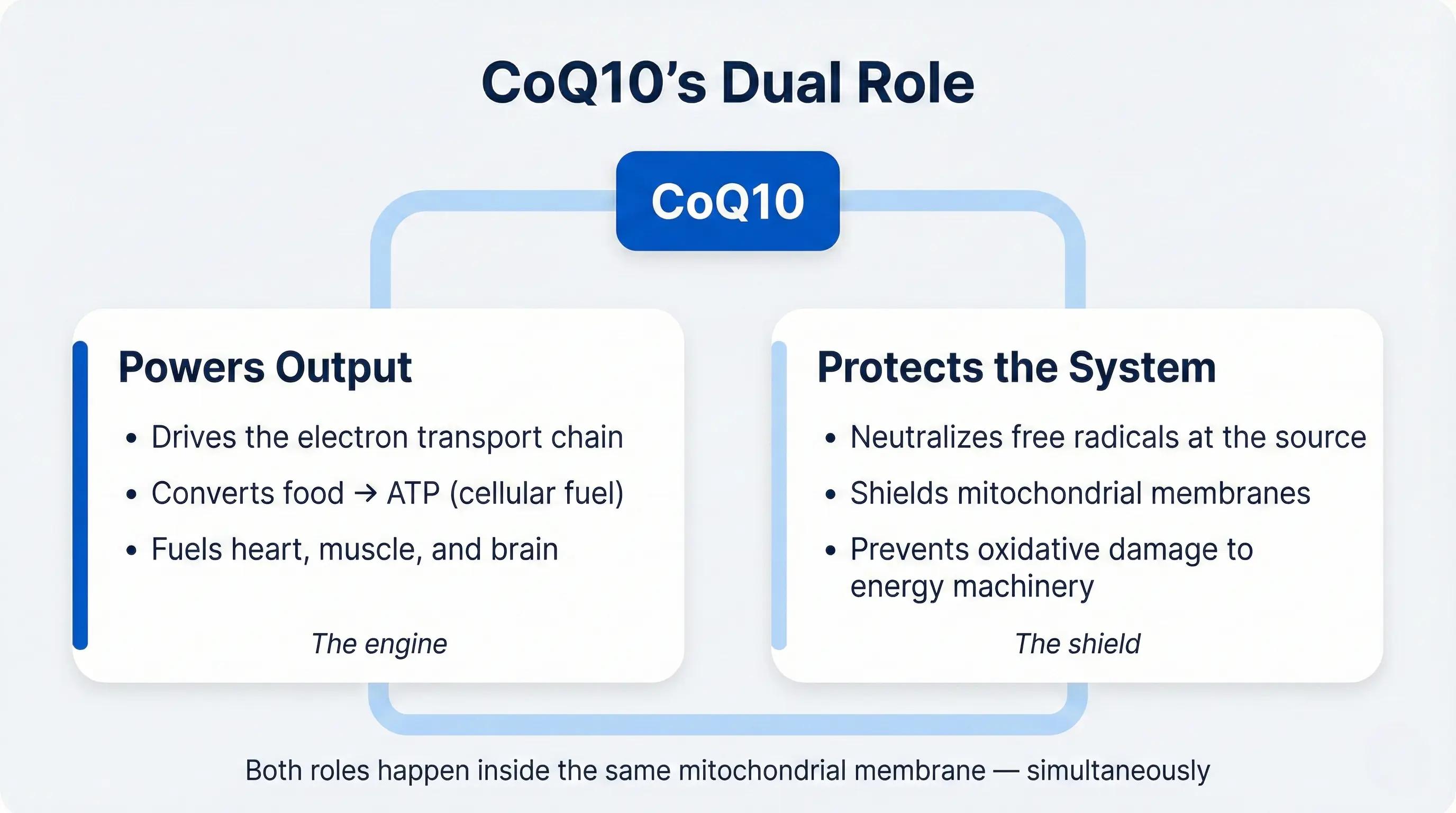
CoQ10 also serves as one of the body's key built-in antioxidants — specifically, one that works inside cell membranes, right where the damage from energy production tends to happen. During normal mitochondrial activity, free radicals are generated as a natural byproduct. In manageable amounts, these are fine — even useful for signaling. But when production outpaces your antioxidant defenses, oxidative stress accumulates, damaging cell membranes, proteins, and DNA.
CoQ10 neutralizes free radicals directly within the mitochondrial membrane, protecting the very machinery that produces your energy. This dual role — energy production and antioxidant defense — is what makes CoQ10 uniquely valuable. It supports output and protects the system simultaneously.
Where CoQ10 levels matter most
Because CoQ10 concentrates in tissues with the highest metabolic activity, the consequences of insufficiency tend to show up in predictable places. The heart — as the most energy-dependent muscle in your body — is particularly sensitive. Skeletal muscles, which drive your training capacity and daily physical performance, are next. The brain, which relies on constant ATP supply for cognition, mood, and neurological function, is also vulnerable.
This pattern — CoQ10 concentrating where energy demand is highest — is why the research has centered on cardiac function, exercise performance, and neurological health, and why supplementation is most relevant for people whose CoQ10 demands are elevated or whose natural production has declined.
Signs You Might Benefit from More CoQ10
CoQ10 isn't routinely tested on standard lab panels, so identifying insufficiency usually comes down to risk factors and symptom patterns rather than a blood draw.
The most common scenario is age-related decline. Your body's CoQ10 production peaks in your mid-20s and gradually decreases from there. By your 40s and 50s, tissue concentrations may be meaningfully lower than they were a decade or two earlier — and the decline accelerates with each passing decade.
Statin medications are the other major factor. Statins lower cholesterol by blocking a specific enzyme in your body's cholesterol production pathway. The catch is that this same pathway also produces CoQ10. So when statins dial down cholesterol synthesis, CoQ10 production gets caught in the crossfire — which is one reason statin users frequently report muscle aches, fatigue, and reduced exercise tolerance.
Beyond age and statins, several other situations can increase your CoQ10 needs or reduce your supply. High training volumes — particularly when combined with caloric restriction during a cut or GLP-1 protocol — place greater demand on mitochondrial output while potentially limiting the raw materials available for CoQ10 synthesis. Chronic illness, oxidative stress, and certain metabolic conditions can also deplete stores faster than your body replenishes them.
Symptoms that may suggest CoQ10 insufficiency include persistent fatigue that doesn't resolve with better sleep, reduced exercise tolerance or a plateau in training capacity, muscle soreness disproportionate to your training load, and a general sense that your recovery isn't keeping pace with your effort.
These are nonspecific signs — they overlap with dozens of other conditions, from iron deficiency to overtraining to thyroid dysfunction. The responsible approach is to address the most common nutritional and hormonal variables first (including B12, vitamin D, magnesium, and testosterone), while including CoQ10 as part of a comprehensive daily supplement for mitochondrial support.
Evidence-Backed Benefits of CoQ10
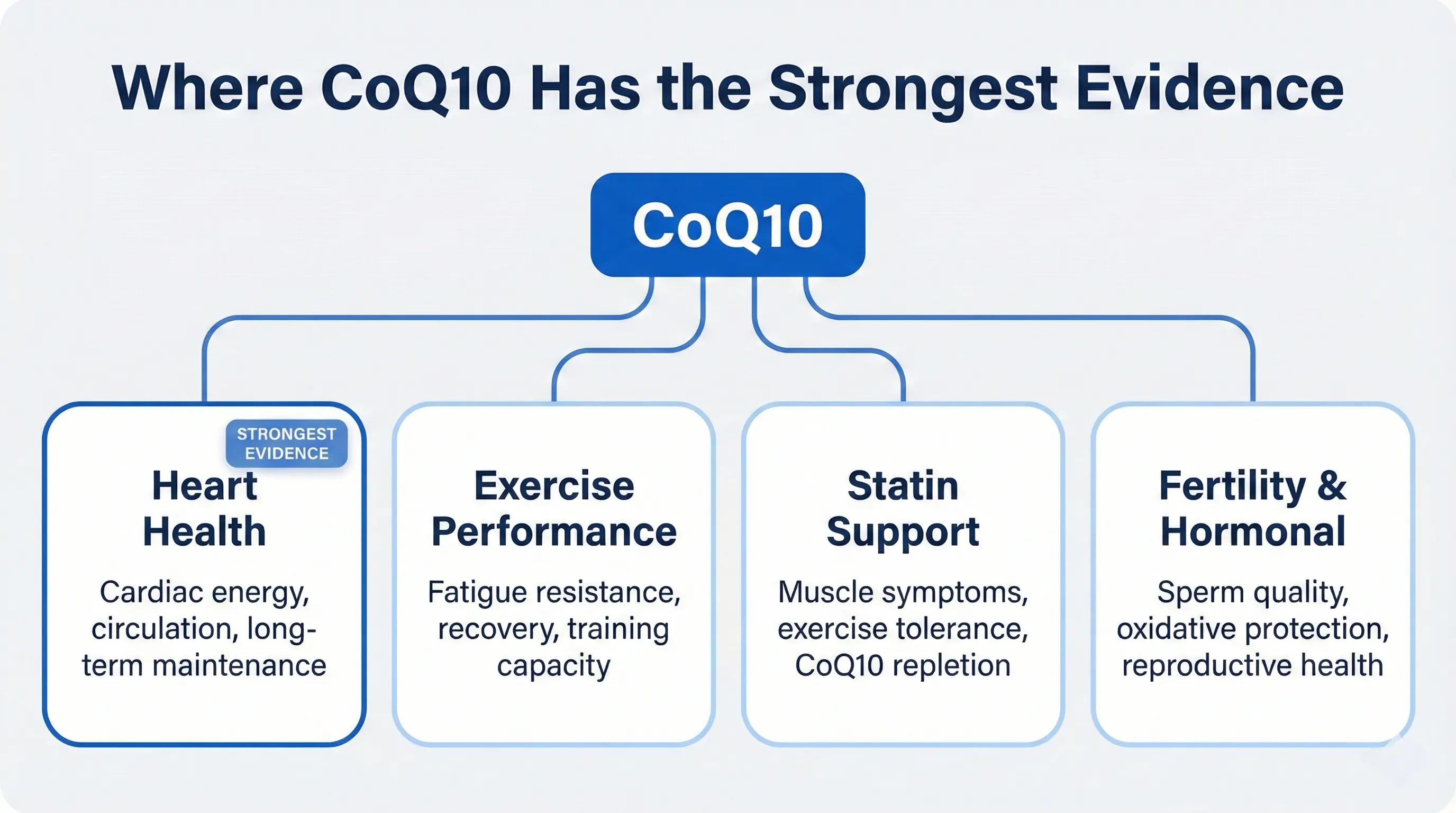
Heart health and circulation
The heart has the highest CoQ10 concentration of any tissue in the body, and the evidence for cardiac benefit is the strongest in CoQ10's clinical profile. Multiple randomized controlled trials have demonstrated that CoQ10 supplementation can support heart function and improve exercise capacity in people with certain cardiac conditions. The landmark Q-SYMBIO trial showed meaningful improvements in cardiovascular outcomes with CoQ10 supplementation over two years in patients with heart failure.
For people without diagnosed heart disease, CoQ10 is best understood as a maintenance strategy — supporting the cellular energy production and antioxidant defense that keep cardiac tissue functioning well over decades. If you have a family history of cardiovascular disease or you're on medications that affect CoQ10 levels, this is particularly relevant.
Exercise performance and recovery
If your mitochondria produce ATP more efficiently, your muscles have more fuel to work with — and that should theoretically improve exercise performance. The research here is promising but nuanced. Studies in CoQ10-depleted individuals (older adults, statin users, people with chronic fatigue) show the clearest improvements in fatigue resistance, perceived exertion, and exercise tolerance after supplementation.
In young, healthy, well-nourished athletes whose CoQ10 levels are already adequate, the effects are more modest. The honest summary: CoQ10 supplementation is unlikely to turn you into a different athlete if your levels are fine. But if your CoQ10 is being pulled down by age, medication, caloric restriction, or sheer training volume, restoring it can meaningfully improve how hard you can push and how quickly you recover.
Statin-associated muscle symptoms
This is one of the most practically relevant applications of CoQ10 supplementation. Statin-associated muscle symptoms — aches, weakness, cramping, exercise intolerance — affect a significant percentage of statin users and are one of the top reasons people discontinue cholesterol medication.
Because statins reduce CoQ10 production through the same pathway they use to lower cholesterol, many clinicians recommend CoQ10 supplementation alongside statin therapy. The clinical evidence is mixed but directionally positive — several trials show reductions in muscle pain and improvements in exercise capacity with CoQ10 in statin users, while others show smaller effects. The risk-benefit profile is favorable: CoQ10 is safe, well-tolerated, and addresses a plausible biological mechanism.
If you're on a statin and experiencing muscle symptoms, bring CoQ10 supplementation up with your prescribing clinician. It's not a guarantee, but it's one of the more reasonable interventions available.
Fertility and hormonal health
CoQ10's antioxidant role extends to reproductive tissue. In men, oxidative stress is a well-established contributor to reduced sperm quality — affecting motility, morphology, and DNA integrity. Several studies have shown that CoQ10 supplementation can improve sperm parameters in men with subfertility, likely through its ability to protect sperm cell membranes from oxidative damage and support the mitochondrial energy production that drives sperm motility.
This doesn't make CoQ10 a fertility treatment on its own, but within Maximus' male optimization lens — where testosterone, metabolic health, and overall vitality are being addressed — it's a reasonable inclusion for men who are thinking about reproductive health as part of the bigger picture.
CoQ10 vs. Ubiquinol vs. Ubiquinone — What's the Difference?
If you've shopped for CoQ10 supplements, you've probably seen two forms: ubiquinone and ubiquinol. The terminology can be confusing, but the distinction is simpler than the marketing around it suggests.
Ubiquinone is the oxidized form of CoQ10 — the form that accepts electrons in the mitochondrial energy chain. Ubiquinol is the reduced form — the form that donates electrons and serves as the active antioxidant. Your body converts freely between the two depending on what's needed, and both forms are present in your cells at all times.
Some supplement brands market ubiquinol as "the active form" and position it as categorically superior. The reality is more nuanced. Ubiquinol does appear to have better absorption in certain populations, particularly older adults whose conversion capacity may be reduced. But ubiquinone has extensive clinical data, good bioavailability in quality formulations, and is more stable (which matters for shelf life and manufacturing consistency).
Building Blocks uses a form selected for bioavailability and stability within the overall formulation, ensuring that CoQ10 reaches the tissues where it's needed most without degrading before you take it. The more important variable than which form you choose is whether you're taking CoQ10 consistently, at an adequate dose, with dietary fat to enhance absorption.
How CoQ10 Fits into Maximus Protocols
For people on a testosterone therapy protocol who are training with high volume and intensity, mitochondrial demand is elevated. You're asking your muscles to generate more force, recover faster, and adapt to greater training stimulus. CoQ10 supports the energy production side of that equation — making sure your mitochondria can actually keep pace with what your optimized hormones are driving your body to do.
For people on GLP-1 weight loss protocols, the case has a different angle. Rapid weight loss combined with caloric restriction creates metabolic stress. Your body is mobilizing stored energy, restructuring body composition, and maintaining essential functions on reduced nutritional input. CoQ10 helps sustain mitochondrial output during this period, supporting training capacity and recovery at a time when preserving lean mass and performance matters most.
For anyone taking statins — whether alongside a Maximus protocol or independently — CoQ10 supplementation addresses the medication-driven depletion that can quietly undermine exercise tolerance and daily energy. And for adults in their 40s, 50s, and beyond, CoQ10 is part of a longevity-oriented approach to maintaining the cellular energy production that naturally declines with age.
We built CoQ10 into Building Blocks because there's no point optimizing hormones and training if your mitochondria can't keep up. The foundation has to match the demand.
Dosing, Timing, and Safety
CoQ10 dosing in the clinical literature typically ranges from 100 to 300 mg per day for general supplementation and heart health support, with some cardiac and fertility studies using higher doses under clinical supervision. For most people taking CoQ10 as part of a daily multivitamin for foundational support, doses in the lower-to-mid range of that spectrum are appropriate and well-supported.
Take CoQ10 with a meal that contains dietary fat. As a fat-soluble compound, its absorption increases substantially when paired with food — the same principle that applies to vitamins D3 and K2. Some people find splitting the dose between morning and evening improves tolerance, though once-daily dosing with a meal is effective for most.
The safety profile of CoQ10 is excellent. It's been studied extensively in clinical trials at doses up to 1,200 mg per day with no serious adverse effects. Mild GI symptoms (nausea, stomach discomfort) are the most commonly reported side effects and are usually dose-dependent and transient.
A few populations should consult their clinician before starting CoQ10: anyone on anticoagulant medications (CoQ10 has a structural similarity to vitamin K and may theoretically affect clotting, though clinical evidence for this interaction is limited), anyone on complex cardiac medication regimens, and pregnant or breastfeeding individuals for whom safety data is less established.
Stacking CoQ10 with Other Mitochondrial and Performance Supports
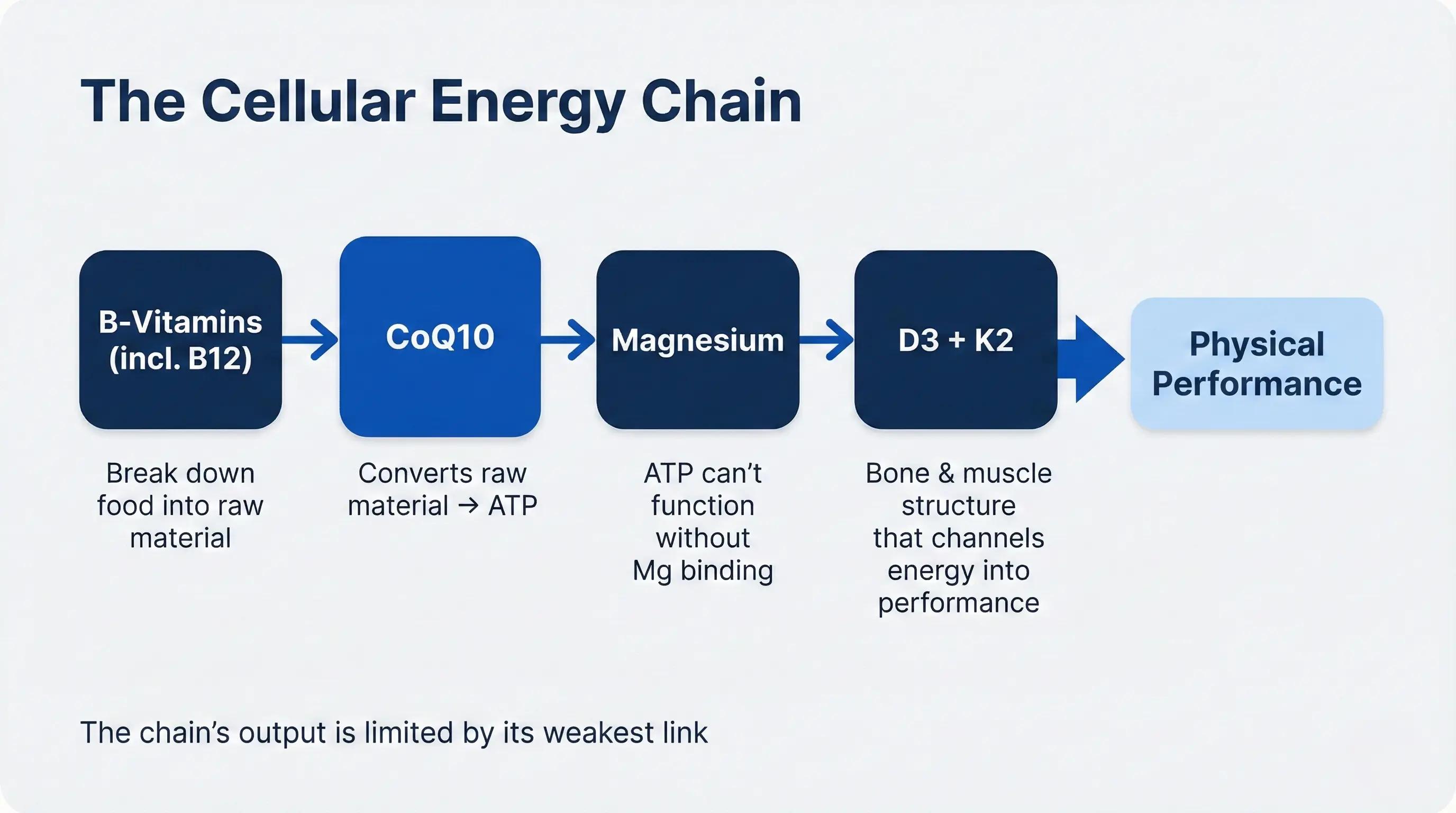
CoQ10 doesn't work in isolation — it's one component of a broader cellular energy system that depends on multiple cofactors.
Magnesium is required for ATP to function — ATP actually exists in your cells bound to magnesium, and without enough of it, the energy CoQ10 helps produce can't be properly utilized. Vitamin D3 and K2 support bone integrity and muscle function — the structural systems that channel your cellular energy into physical performance. B-vitamins, including B12, are cofactors in the earlier stages of energy metabolism — the steps that break down food into the raw material your mitochondria use to produce ATP.
This is why Building Blocks includes CoQ10 alongside these cofactors in a single daily formulation rather than as a standalone supplement. The mitochondrial energy system is a chain, and the output is limited by whichever link is weakest. Addressing CoQ10 while ignoring magnesium, B12, or D3 — or vice versa — leaves gaps that limit the return on each individual nutrient.
Layer testosterone optimization and structured resistance training on top of a complete micronutrient foundation, and you have a system where every component is pulling in the same direction.
Your Mitochondria Don't Care About Hype
CoQ10 won't trend on social media. It doesn't have a flashy mechanism or a dramatic before-and-after story. What it has is decades of clinical evidence showing that when your cells have enough of it, your heart works better, your muscles recover faster, and your energy holds up under the kind of demand that serious training, aging, and metabolic protocols put on your body.
For adults over 35, statin users, and anyone pushing hard physically while managing hormones or body composition, CoQ10 fills a gap that most people don't realize they have — because the decline is gradual and the symptoms are easy to blame on something else. Building Blocks includes it because the formulation was designed around a simple question: what does a body under real performance demand actually need? CoQ10 is one of the clearer answers.
FAQs about CoQ10
How long does it take to feel CoQ10's effects?
CoQ10 builds up in tissues gradually. Most people who are going to notice a difference — particularly in exercise tolerance, fatigue levels, or muscle comfort — begin to see changes within two to four weeks. For statin-associated muscle symptoms, some studies show improvement within four to six weeks. If you're not depleted, the effects may be more subtle and reflect long-term maintenance rather than a noticeable acute shift. Consistency matters more than any single dose.
Is CoQ10 safe to take with statins?
Yes, and many clinicians specifically recommend it for statin users because of the medication's effect on your body's own CoQ10 production. That said, always discuss supplement additions with the clinician who prescribes your statin. They can advise on dosing, monitor for interactions with the rest of your medication regimen, and track whether your symptoms improve.
What time of day should I take CoQ10?
With a meal containing dietary fat, for best absorption. Morning or midday is the most common recommendation, particularly if you find CoQ10 mildly energizing (some people do, though it's not a stimulant in the traditional sense). If you're taking it as part of Building Blocks, morning with breakfast is the simplest routine. Splitting the dose between two meals is also reasonable if your clinician recommends a higher total daily amount.
Do I still need coffee or pre-workout if I take CoQ10?
They serve different purposes. CoQ10 supports mitochondrial ATP production — the baseline cellular energy that fuels all your bodily functions. Caffeine blocks adenosine receptors to temporarily reduce perceived fatigue and increase alertness. Pre-workouts typically combine caffeine with other acute performance enhancers. You can use both, but understand that CoQ10 is building your energy foundation over weeks and months, while caffeine is manipulating your perception of fatigue in the moment. They're complementary, not interchangeable.