Vitamin B12 for Energy: How It Works and Who Actually Needs It
Key Takeaways
B12 supports energy by helping your body produce red blood cells and convert food into ATP. It doesn't work like caffeine or a stimulant.
If you're genuinely B12-deficient, correcting it can dramatically improve fatigue, brain fog, and exercise tolerance.
If your levels are already adequate, extra B12 won't noticeably change how you feel — it just keeps you topped off.
For most people, daily oral methylcobalamin is more practical than chasing B12 energy shots, which are really designed for confirmed deficiency or malabsorption.
Building Blocks includes methylcobalamin at a performance-oriented daily dose, so B12 isn't the weak link when you're on a testosterone or GLP-1 protocol.
Why Is Everyone Talking About B12 for Energy?
You're tired. Maybe you're a few months into a GLP-1 protocol and your energy doesn't match your progress on the scale. Maybe you're training hard on a testosterone protocol and feel more drained than you should. Maybe you're working 60-hour weeks and someone at the office just told you about their "life-changing" B12 shot.
The question most people are really asking is simple: does B12 give you energy?
The short answer is yes — but only if you're low. And the difference between "fixing a real deficiency" and "megadosing when you're already fine" is the difference between a genuine improvement and expensive urine. This guide breaks down exactly how B12 relates to energy, who stands to benefit the most, and how to approach it without wasting time or money.
For a broader look at what B12 does beyond energy — including its role in nerves, methylation, and brain health — see our complete vitamin B12 benefits guide.
How Vitamin B12 Actually Supports Energy Production
Mitochondria and ATP
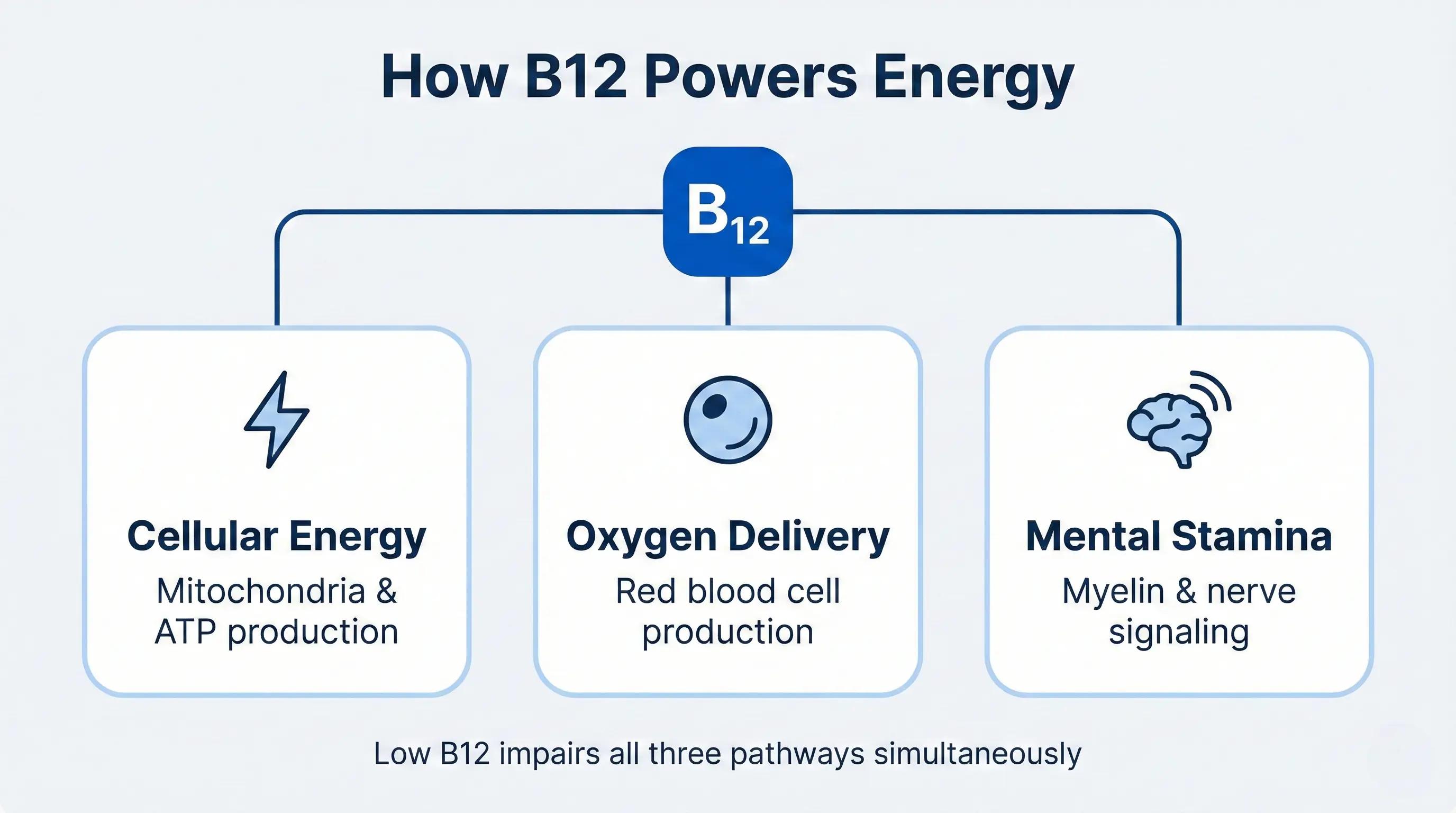
Every cell in your body runs on ATP — adenosine triphosphate — and B12 is part of the enzymatic machinery that produces it. Specifically, B12 (as adenosylcobalamin) is a cofactor in the mitochondrial pathway that converts certain fatty acids and amino acids into usable fuel. When B12 is low, this process becomes less efficient. Your mitochondria are still running, but they're running with a missing tool. The result isn't dramatic collapse — it's a slow, persistent drag on your energy that's easy to blame on sleep, stress, or aging.
Red blood cells and oxygen delivery
B12 is required for producing normal, functional red blood cells. Without enough of it, your body starts making red blood cells that are too large and structurally abnormal — a condition called megaloblastic anemia. These oversized cells are poor oxygen carriers, which means less oxygen reaching your muscles, brain, and organs.
In practical terms, that shows up as fatigue that seems disproportionate to your effort, shortness of breath during workouts that used to feel manageable, and a general sense that your body isn't performing the way it should. If you've ever felt like you hit a ceiling in the gym despite doing everything else right, inadequate oxygen delivery is one of the less obvious places to look.
Nervous system and mental stamina
Energy isn't just physical. B12 maintains the myelin sheath around your nerves, which keeps signals moving fast and accurately between your brain and body. When B12 drops, mental energy often goes with it — concentration suffers, reaction time slows, motivation dips, and you may notice a persistent brain fog that doesn't respond to more sleep or better nutrition.
This is why B12 deficiency gets mistaken for burnout, depression, or just "getting older." The symptoms overlap. But the fix — when it is B12 — is much more straightforward than overhauling your entire life.
Signs You Might Need More B12
If the fatigue you're experiencing has a B12 component, the signs tend to cluster in recognizable patterns.
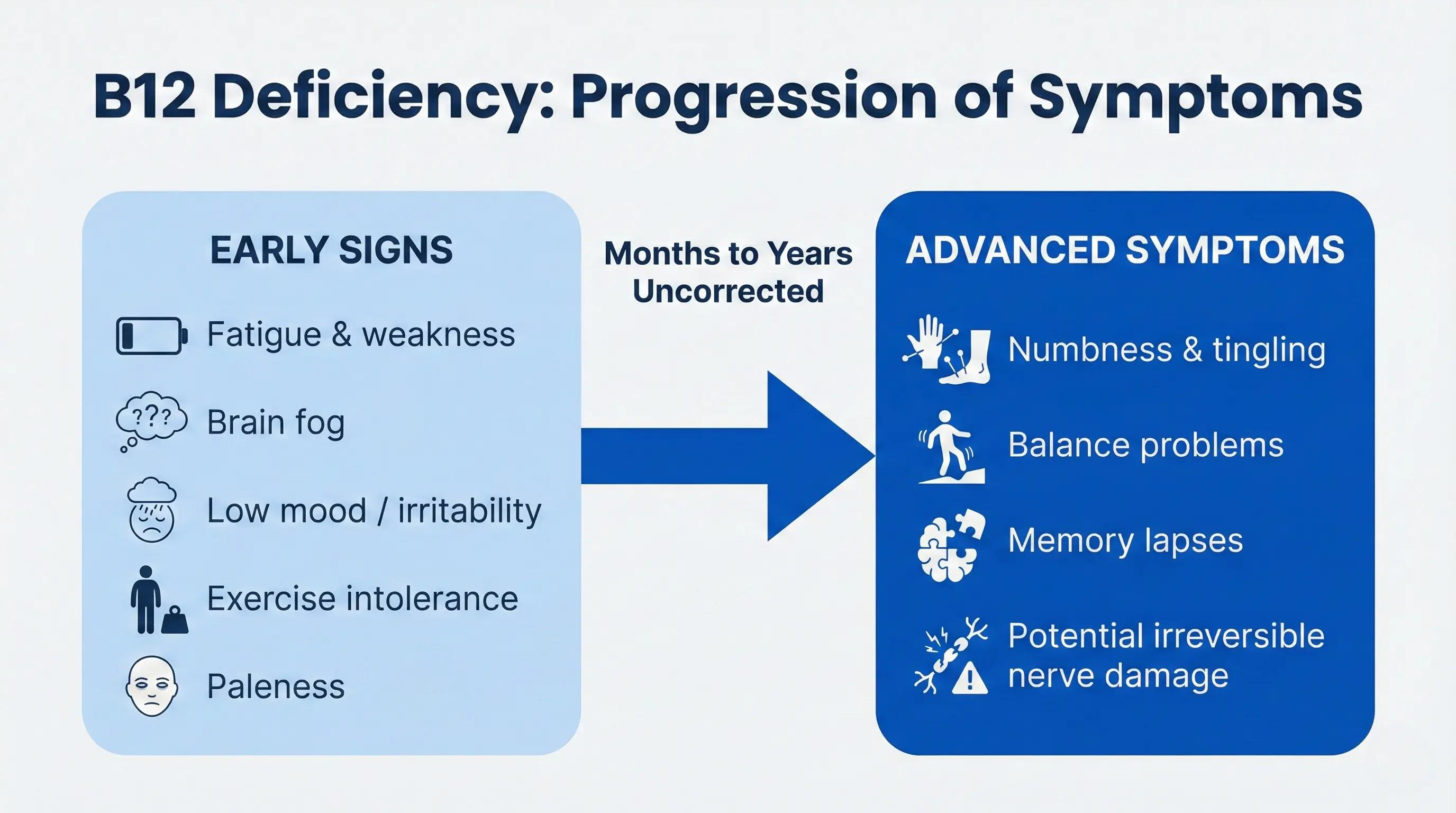
On the physical side, you might notice constant tiredness that doesn't improve with rest, heavy legs during workouts, shortness of breath on efforts that shouldn't wind you, pale skin, and a need for frequent napping. On the cognitive side, brain fog, slower reaction time, difficulty concentrating, and headaches are common. Mood shifts — low motivation, irritability, a general flatness — often travel alongside these symptoms.
Several situations raise the odds that B12 is part of the picture. If you're on a GLP-1 weight loss protocol and eating significantly less, your B12 intake may have dropped with your appetite. If you eat very little meat, fish, eggs, or dairy — or none at all — dietary B12 is likely insufficient. Long-term use of metformin or proton pump inhibitors (PPIs) impairs B12 absorption over time. And if you're over 50, your ability to extract B12 from food naturally declines.
The important step before self-treating with megadoses is confirming where you actually stand. A serum B12 test (and ideally methylmalonic acid or homocysteine if your B12 is borderline) gives you a real answer rather than a guess. If fatigue is severe, sudden, or unexplained, bring it to your clinician — B12 is one possible factor, but it's not the only one worth ruling out.
Will B12 Give Me More Energy If I'm Not Deficient?
This is where honesty matters more than marketing.
Deficiency vs. optimization vs. superdosing
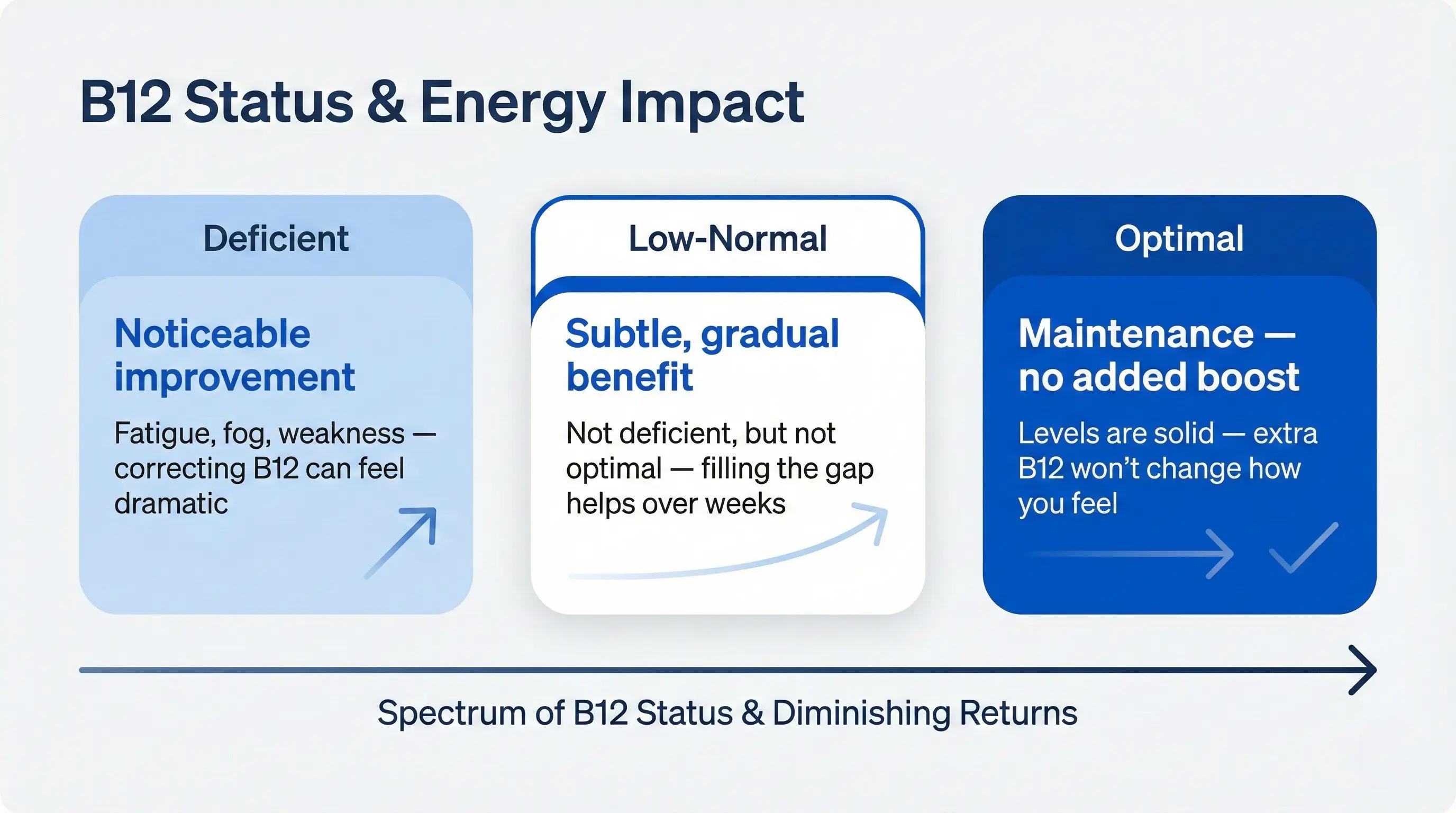
Think of B12 status in three tiers. If you're deficient, correcting it produces a noticeable — sometimes dramatic — improvement in energy, stamina, and mental clarity. If you're adequate but on the lower end of normal, optimizing your levels may produce a subtle, gradual benefit. And if your B12 is already solidly in the optimal range, adding more on top of that does very little. Your body is water-soluble B12's landlord, not its storage unit — excess gets excreted, not stockpiled.
Why some people feel a "B12 boost"
There's a reason B12 shots have a reputation for making people feel incredible, even when their levels aren't clearly deficient. In some cases, the shot corrected a mild deficiency the person didn't know they had. In others, the "energy blend" at the clinic included caffeine, other B-vitamins, or amino acids that produced the kick. And placebo is real — getting an injection in a clinical setting with the expectation of feeling better is a powerful experience.
None of that means B12 is useless. It means you should direct your effort where the return is highest: confirm your status, correct any genuine gap, and then maintain it. That's the high-ROI move.
B12 Energy Shots vs. Daily Supplements
What's in a typical B12 shot?
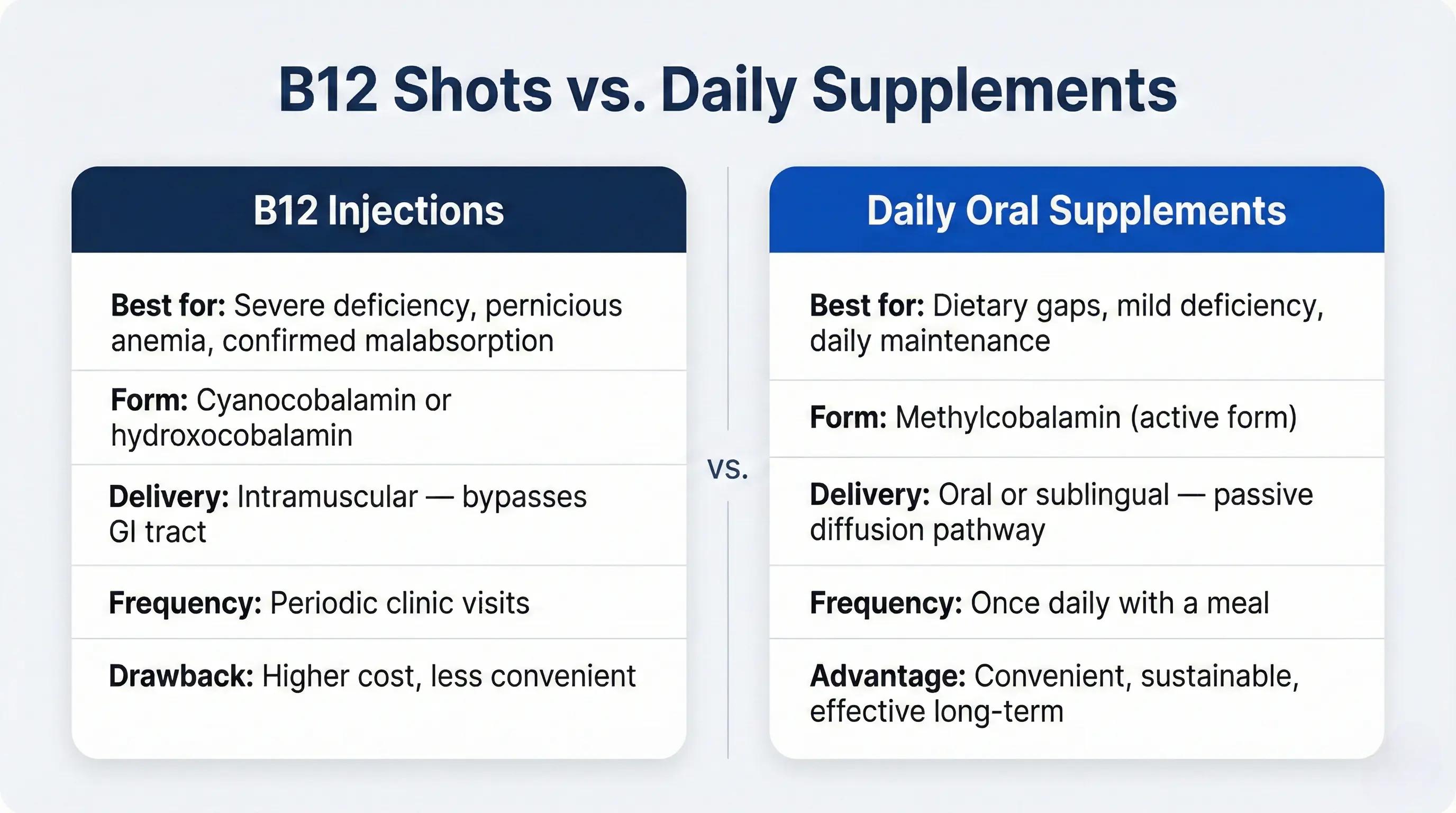
Most B12 injections deliver a high dose — typically 1,000 mcg — of cyanocobalamin or hydroxocobalamin directly into muscle tissue. This bypasses the GI tract entirely, which is the whole point: it's designed for people whose digestive system can't absorb B12 reliably.
When shots make sense (and when they don't)
Injections are the right call in specific situations: confirmed severe deficiency, pernicious anemia (where intrinsic factor is absent), or documented malabsorption that has failed to respond to oral supplementation. In these cases, shots deliver B12 directly into circulation and can start replenishing stores quickly.
For everyone else — people with dietary gaps, mild deficiency, or those simply wanting to maintain good levels — injections are usually overkill. They require clinic visits, they cost more, and they don't offer a meaningful advantage over high-dose oral supplementation when absorption isn't the problem.
Oral methylcobalamin for everyday energy support
Research has shown that high-dose oral B12 — even in people with some absorption challenges — can achieve adequate blood levels through passive diffusion, a secondary absorption pathway that doesn't depend on intrinsic factor. For daily maintenance and optimization, oral or sublingual methylcobalamin is effective, convenient, and far more sustainable than recurring injections.
The practical conclusion: for most people with mild low B12 or dietary gaps, daily methylcobalamin in a quality multivitamin is a better long-term strategy than chasing energy shots. Save the needles for situations where your clinician confirms they're needed. (For more on how forms compare, see the forms and dosing section of our B12 guide.)
How Long Does It Take for B12 to Work for Energy?
If you're clearly deficient and start appropriate supplementation or injections, many people notice energy improvements within one to two weeks. Brain fog and mental stamina tend to follow shortly after. More subtle improvements — mood, motivation, exercise tolerance — may take four to eight weeks to fully develop.
If your deficiency is borderline and you're filling a smaller gap, the improvements are often more gradual and harder to pinpoint. You might not have a dramatic "before and after" moment, but over a few weeks, things just start working better — sleep feels more restorative, workouts feel less effortful, and the afternoon slump eases.
Several factors influence the timeline. The severity and duration of your deficiency matters — someone who's been low for years will take longer to fully recover than someone who's been trending down for a few months. The dose and route (injection vs. oral) play a role. And other concurrent issues can mask progress: if your sleep is poor, your iron is low, your thyroid is off, or your testosterone is suboptimal, fixing B12 alone won't solve everything.
The key expectation to set: B12 is a repair and support nutrient, not a same-day stimulant. Give it time, address the other variables, and track how you feel over weeks — not hours.
Best Vitamin B12 for Energy: Form, Dose, and the Bigger Picture
Choosing the right form
For daily energy support, methylcobalamin is the stronger choice. It's already in the active form your body uses for methylation and cellular energy processes, which means no extra conversion steps. Cyanocobalamin works fine in many clinical contexts (and is the standard for injections), but as a daily supplement for long-term optimization, methylcobalamin is more direct and more commonly preferred by performance-oriented clinicians.
How much B12 for energy?
The goal isn't to megadose — it's to restore and maintain levels in the high-normal range where your cells have what they need. Common daily supplement doses range from 500 to 2,500 mcg depending on individual absorption, dietary intake, and clinical context. Your provider can help dial in the right amount based on your labs.
B12 is one piece of the energy puzzle
This is worth saying clearly: B12 matters, but it's not the whole story. If your energy is off, other factors deserve equal attention — iron status, sleep quality and duration, training load and recovery, testosterone levels, thyroid function, and how your GLP-1 protocol is affecting your overall nutrient intake. B12 is one essential piece in that picture. So is magnesium, vitamin D3, and the other micronutrients that keep your energy systems running.
This is why we built methylcobalamin into Building Blocks — so a foundational nutrient like B12 isn't the bottleneck when you're investing in protocols designed to optimize how you feel, train, and perform.
So, Does B12 Give You Energy?
It depends entirely on where you're starting. If you're in a risk group — reduced food intake on GLP-1s, plant-based diet, long-term metformin or PPI use, over 50 — and fatigue is dragging you down, checking your B12 is one of the highest-ROI moves you can make. Correcting a genuine deficiency can meaningfully change how you feel within weeks.
If your levels are already solid, more B12 won't replace better sleep, smarter training, or dialing in the other variables. That's not a failure of B12 — that's how targeted nutrition works. You fix what's broken, maintain what's working, and stop throwing resources at problems that live somewhere else. Get labs, correct any gap, and then keep your levels covered with a daily supplement like Building Blocks so you can focus on the things that actually move the needle.
Vitamin B12 for Energy — FAQs
Is it safe to take B12 every day for energy?
Yes, for the vast majority of people. B12 is water-soluble, meaning your body excretes what it doesn't need rather than storing it to potentially harmful levels. There's no established tolerable upper intake limit from major health authorities. That said, daily supplementation is most valuable when it's part of a broader, well-formulated approach — not a standalone "energy pill." If you have complex medical conditions or are on multiple medications, run your supplement stack by your clinician.
Should I take B12 in the morning or before a workout?
Morning with a meal is the simplest, most consistent approach. B12 supports energy metabolism throughout the day — it doesn't need to be timed to your workout like creatine or caffeine. Taking it as part of your daily multivitamin with breakfast keeps it routine and ensures absorption alongside other fat-soluble nutrients in your stack.
Can I combine B12 with coffee or pre-workout?
Absolutely. B12 and caffeine work through completely different mechanisms — B12 supports cellular energy production, while caffeine blocks adenosine receptors to reduce perceived fatigue. They don't compete or interact negatively. The bigger thing to watch is your total caffeine intake and whether it's cutting into your sleep, since poor sleep will undermine any micronutrient strategy.
What if I take B12 and still feel exhausted?
If you've confirmed your B12 levels are adequate and you're still fatigued, it's time to widen the investigation. Ask your clinician about iron and ferritin, thyroid function (TSH, free T3/T4), testosterone levels, and sleep quality (including possible sleep apnea). Mental health — chronic stress, anxiety, depression — also drives fatigue that no vitamin will fix on its own. B12 is one important piece, but persistent exhaustion usually has more than one contributing factor. For the mood and cognitive side of this, see our guides on B12 for brain health and B12 for mood and anxiety.