B12 is essential for myelin maintenance, neurotransmitter production, and vascular health in the brain — all of which directly affect memory, focus, and processing speed.
Low B12 can cause brain fog, poor concentration, mood changes, and in severe cases, dementia-like symptoms that mimic cognitive decline.
Correcting a genuine deficiency can dramatically improve cognition. Adding more B12 on top of already-normal levels produces more modest effects.
Long-term B12 optimization is one of the more straightforward pieces of cognitive insurance available — especially for people over 50, those on metformin or PPIs, and anyone on a GLP-1 protocol with reduced food intake.
Building Blocks provides methylcobalamin as part of a brain-protective foundation alongside sleep, training, and hormone optimization.
Why B12 Matters for Your Brain
You're rereading the same email for the third time and still not absorbing it. You walked into a room and forgot why. Names you've known for years take an extra beat to surface. You're chalking it up to stress, aging, or just being busy — and maybe that's all it is. But there's also a straightforward biological explanation worth ruling out.
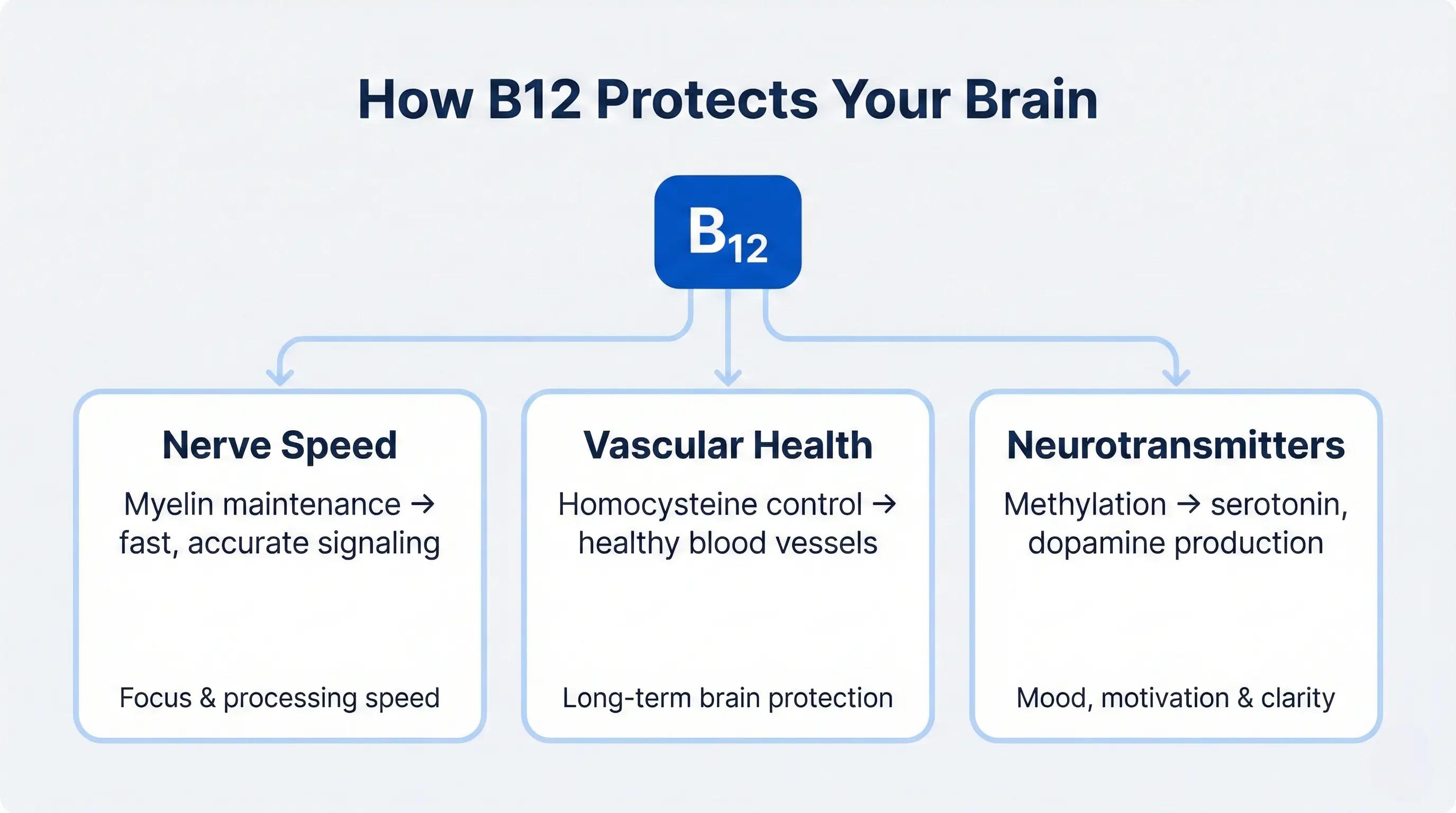
Vitamin B12 is one of the nutrients your brain depends on most. It maintains the myelin sheath that insulates your nerve fibers and keeps signals moving fast. It supports DNA synthesis in brain cells that are constantly turning over and repairing. And it drives the methylation cycle — the biochemical pathway responsible for producing neurotransmitters like serotonin, dopamine, and norepinephrine.
When B12 is low, all three of those systems slow down. The result isn't always dramatic — it's often a quiet, creeping decline in mental sharpness that's easy to normalize. This article covers what B12 actually does for your brain, when optimizing it makes a real difference, and where it fits within a broader strategy for protecting cognition over the long term. For a full overview of B12 beyond brain health, see our vitamin B12 benefits guide.
How Vitamin B12 Affects Memory, Focus, and Mood
Myelin and nerve signaling speed
Myelin is the fatty coating that wraps around nerve fibers throughout your brain and body. It works like insulation on electrical wiring — without it, signals slow down, degrade, or misfire entirely. B12 is required for the synthesis and maintenance of myelin. When B12 drops, demyelination begins — gradually at first, then more noticeably.
In the brain, this translates to slower processing speed, difficulty concentrating, and the foggy, sluggish feeling that many people describe as "not thinking clearly." In the peripheral nervous system, it shows up as numbness, tingling in the hands and feet, and balance problems. These neurological signs are among the most clinically significant consequences of B12 deficiency — and some of them can become permanent if the deficiency persists too long.
Homocysteine, blood vessels, and the aging brain
B12, along with folate and B6, is responsible for converting homocysteine into methionine. When B12 is insufficient, homocysteine accumulates. Elevated homocysteine has been consistently associated with accelerated brain atrophy, vascular damage in small cerebral blood vessels, and increased risk of cognitive decline in aging populations.
The mechanism isn't mysterious: your brain runs on blood flow. When the vasculature that feeds it is compromised by inflammation and endothelial damage — which chronically elevated homocysteine promotes — cognitive performance suffers. Keeping homocysteine in a healthy range through adequate B12, folate, and B6 is one of the more evidence-supported nutritional strategies for long-term brain protection.
Neurotransmitters and mental clarity
B12 participates directly in the synthesis of serotonin, dopamine, and other neurotransmitters that regulate mood, motivation, and mental clarity. This is why B12 deficiency doesn't just produce "brain fog" in the cognitive sense — it often shows up emotionally as well. Low mood, irritability, a persistent flatness or lack of drive, and reduced stress tolerance frequently accompany the memory and focus complaints.
These mood symptoms overlap significantly with depression and anxiety, which is why B12 deficiency is sometimes misdiagnosed as a purely psychiatric issue. If you're experiencing cognitive and emotional changes simultaneously — especially alongside fatigue or neurological symptoms like tingling — B12 status deserves a look before or alongside other evaluations. For a deeper dive into the mood dimension, see our guide on vitamin B12 for anxiety and mood.
Brain Fog vs. True B12 Deficiency — How to Tell the Difference
"Brain fog" is one of the most common complaints in modern health — and one of the least specific. Poor sleep, chronic stress, dehydration, blood sugar swings, hormonal shifts, and a dozen other factors can all produce it. So how do you know when B12 might be driving yours?
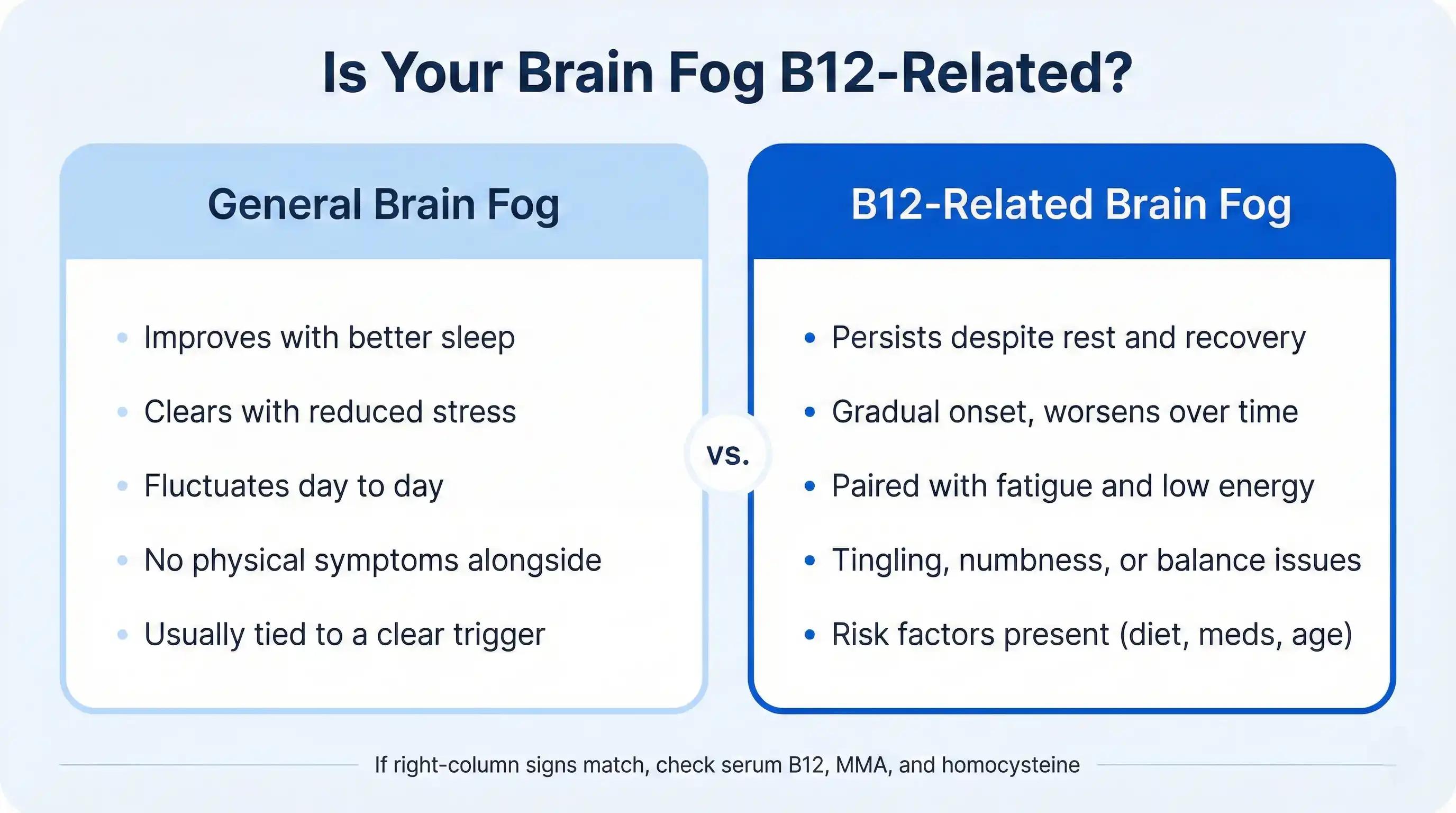
The pattern that suggests B12 involvement tends to include cognitive symptoms alongside physical ones. Memory lapses and word-finding difficulty paired with unusual fatigue. Difficulty concentrating combined with tingling or numbness in the hands or feet. Brain fog that came on gradually and doesn't improve with more sleep, less caffeine, or time off. Pallor, tongue soreness, or changes in balance or coordination round out the picture.
Context matters too. Your risk is elevated if you're over 50 (stomach acid production and intrinsic factor decline with age), eating a plant-based or low-meat diet, taking metformin or proton pump inhibitors long-term, managing a GI condition that affects absorption, or on a GLP-1 protocol where significantly reduced food intake has persisted for months.
If this picture resonates, the next step is lab work — not guesswork. Serum B12 is the starting point, with methylmalonic acid (MMA) and homocysteine adding sensitivity if your B12 comes back borderline. What makes early detection especially important for brain health is that prolonged B12 deficiency can cause neurological damage that doesn't fully reverse even after levels are restored. The earlier you catch it, the more completely you recover.
Can Vitamin B12 Improve Memory If Your Levels Are "Normal"?
This is the question that separates responsible advice from marketing hype, and it deserves a direct answer.
When B12 is genuinely low, correcting it produces meaningful — sometimes dramatic — improvements in cognition. Brain fog lifts, processing speed improves, concentration returns, and the emotional flatness that often accompanies deficiency begins to resolve. The evidence here is strong and clinically well established.
For people whose B12 is already in the normal range, the picture is more nuanced. Large trials examining B12 supplementation (often combined with folate and B6) in non-deficient older adults have shown modest benefits — primarily in slowing homocysteine-related brain atrophy rather than producing noticeable "smarter" effects. A few studies show subtle improvements in specific cognitive domains, but the effect sizes are small and inconsistent.
The honest conclusion: B12 is necessary for brain health and worth optimizing to the high end of normal, but it's not a nootropic in the traditional sense. If your levels are already solid, adding more B12 won't make you noticeably sharper. What it does is remove a potential bottleneck and protect against the gradual decline that unchecked insufficiency produces over years and decades.
Maximus' position on this is practical: we care about getting you from borderline to optimal, not just above the deficiency line. That's a meaningful difference when the organ in question is your brain.
Vitamin B12 and Long-Term Cognitive Protection
The conversation around B12 and the brain isn't just about fixing today's brain fog. It's also about what happens over the next ten, twenty, or thirty years.
B12 deficiency becomes more common with age — not because older adults eat worse, but because the biological machinery required to absorb B12 (stomach acid, intrinsic factor, healthy gut lining) degrades over time. Studies consistently show that a significant percentage of adults over 60 have suboptimal B12 status, and that this correlates with faster rates of brain atrophy and cognitive decline.
Long-term low B12 has been linked to dementia-like symptoms that are sometimes misattributed to Alzheimer's disease or general aging. In some of these cases, B12 repletion partially or fully reverses the cognitive impairment — which means the diagnosis was wrong and the actual problem was treatable all along. Not every case of "age-related" memory loss is inevitable.
This is where a preventive mindset matters most. Regular lab monitoring in higher-risk groups, consistent daily intake through diet and a quality supplement, and early correction of any downward trend — these are low-friction strategies with outsized long-term value. It fits directly into the way Maximus approaches health more broadly: build the foundation now, maintain it consistently, and invest in the protocols that compound over time.
How to Use B12 Intelligently for Brain Health
Testing and targets
If you're noticing cognitive changes and have any of the risk factors discussed above, get tested before reaching for megadoses. Serum B12 alone can miss functional deficiency — ask your provider about MMA and homocysteine if your result is borderline or your symptoms don't match a "normal" number. Knowing your actual status lets you target your approach rather than guessing.
Best form of B12 for brain health
Methylcobalamin is the preferred form for daily brain-protective supplementation. It's the active methyl donor form that participates directly in methylation and neurotransmitter synthesis — no conversion required. Adenosylcobalamin, the other active coenzyme form, supports mitochondrial energy production in neural tissue and may complement methylcobalamin in certain formulations. Cyanocobalamin works and has extensive clinical use, particularly in injection form, but requires extra metabolic steps to reach the active state.
For ongoing daily maintenance, oral or sublingual methylcobalamin is effective for most people. Injections are reserved for severe deficiency, pernicious anemia, or documented malabsorption — your clinician can guide that decision based on your labs and history.
Dosing strategy
The approach is two-phase. If you're correcting a confirmed deficiency, your provider will typically prescribe a repletion protocol — higher doses (oral or injection) for a set period to rebuild stores. Once levels are restored, you transition to a daily maintenance dose designed to keep you in the optimal range long-term.
Building Blocks provides methylcobalamin at a maintenance dose calibrated for this second phase — consistent, daily, integrated with other B-vitamins and methylation cofactors. It's designed so that one of the most basic nutrients your brain needs is never the thing holding you back.
Stacking B12 with other brain-protective habits
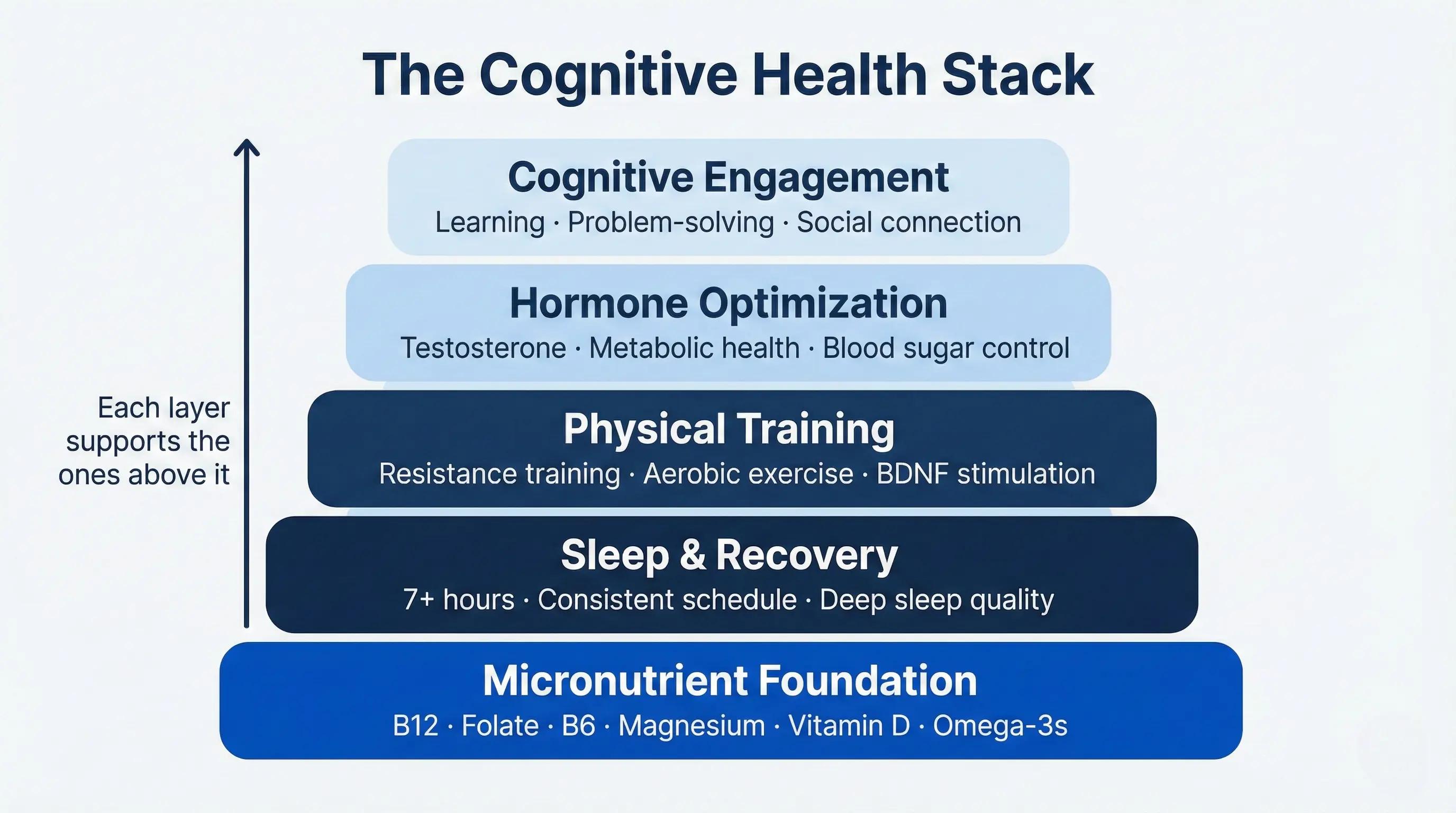
B12 doesn't work in isolation, and neither does any single nutrient when it comes to cognition. The strongest evidence for long-term brain health points to a combination of factors working together: quality sleep (seven-plus hours, consistently), regular resistance and aerobic training, testosterone in an optimal range for men who are experiencing age-related decline, blood sugar control and metabolic health, omega-3 fatty acids, magnesium (particularly for sleep quality and stress regulation), and vitamin D3 — all of which work alongside B12 to keep the brain well supplied, well protected, and performing at its best.
We built methylcobalamin into Building Blocks so that our patients' brains are never operating without one of the most fundamental nutrients in the stack. From there, the protocols, the training, and the lifestyle habits layer on top of a foundation that's already solid.
Protecting Your Brain Starts with the Basics
For anyone experiencing cognitive fog, memory lapses, or mood changes — especially alongside fatigue or neurological symptoms — checking B12 is one of the lowest-friction, highest-return moves available. Correcting a genuine deficiency can meaningfully change how your brain functions within weeks.
For people whose levels are already solid, the value shifts from correction to protection. Maintaining optimal B12 status won't make you limitless, but it guards against the slow neurological erosion that unchecked insufficiency produces over decades. That's the kind of long-game thinking that separates people who age well from those who don't — and it's exactly the logic behind including B12 in Building Blocks at a dose designed for optimization, not just deficiency avoidance.
Vitamin B12 for Memory & Brain Health — FAQs
How long does it take for B12 to improve brain fog?
It depends on the severity and duration of the deficiency. For mild-to-moderate deficiency, many people notice improvements in mental clarity, concentration, and energy within two to four weeks of starting supplementation. More established deficiency — especially if neurological symptoms like numbness or balance issues are present — can take several months to improve, and some neurological effects may not fully reverse if the deficiency was prolonged. The earlier you identify and correct it, the faster and more complete the recovery.
Can B12 supplements prevent Alzheimer's disease?
There's no supplement that can guarantee prevention of Alzheimer's. What the evidence does support is that adequate B12 (along with folate and B6) helps keep homocysteine levels in check, and that chronically elevated homocysteine is associated with accelerated brain atrophy and higher dementia risk. Maintaining optimal B12 status is one evidence-based strategy for reducing modifiable risk factors — it's part of a broader approach that includes exercise, sleep, metabolic health, and cognitive engagement. Think of it as brain maintenance, not a silver bullet.
Is sublingual B12 better than capsules for brain health?
Both can work. Sublingual B12 is absorbed through the mucous membranes under the tongue, which bypasses the GI tract and may offer a slight advantage for people with digestive or absorption issues. For most people with normal GI function, a quality capsule or tablet containing methylcobalamin is equally effective. The more important variable is form (methylcobalamin over cyanocobalamin for daily use) and consistency (taking it daily rather than sporadically). If you have confirmed malabsorption, talk to your provider about the best route for your situation.
Should I give B12 to my parents for memory problems?
It's a reasonable question, but the right first step is a medical evaluation — not a supplement. Memory problems in older adults can reflect many things: B12 deficiency, thyroid dysfunction, medication side effects, depression, sleep disorders, or neurodegenerative conditions. B12 testing should absolutely be part of that workup, because deficiency is common in older adults and produces symptoms that closely mimic early dementia. If their B12 is low, correcting it can make a significant difference. But self-treating without labs risks masking a different problem that needs attention.