Testosterone Levels By Age: Normal Ranges, Signs of Low T, and When to Act
You're not imagining it. That energy dip, the stubborn weight gain, the fading motivation—these aren't just signs of "getting older." For millions of men (and women too), they're symptoms of declining testosterone levels, a natural process that starts earlier than most people realize.
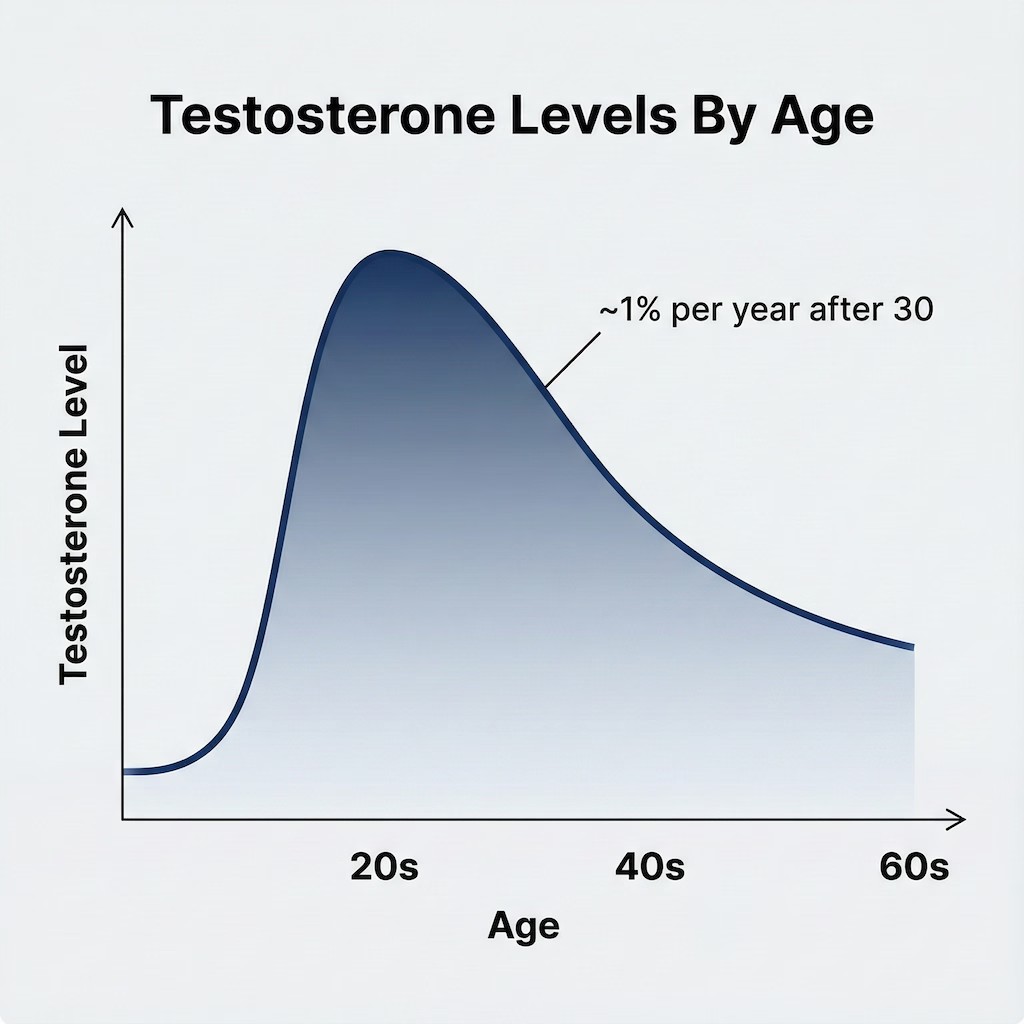
Here's what catches people off guard: testosterone doesn't wait until you're 60 to start dropping. It peaks in your late teens to early twenties, then begins a slow, steady decline—roughly 1% per year after age 30. That's the average. Some men experience steeper drops. Others maintain robust levels well into their 70s.
The problem? Most people don't know what their testosterone levels actually are, let alone what's considered normal for their age. They assume feeling tired and mentally foggy is just part of aging. Sometimes it is. But often, it's a correctable hormonal issue that's quietly undermining their quality of life.
If you're curious about where you stand, you can test your testosterone levels from home with our at-home test kit. But whether you test now or later, understanding what those numbers mean—and what's actually normal for your age—is the first step.
Let's start with how testosterone changes across your lifetime, from the surge at puberty to the gradual decline that begins sooner than most men expect.
The Testosterone Lifecycle: How Levels Change From Birth Through Aging
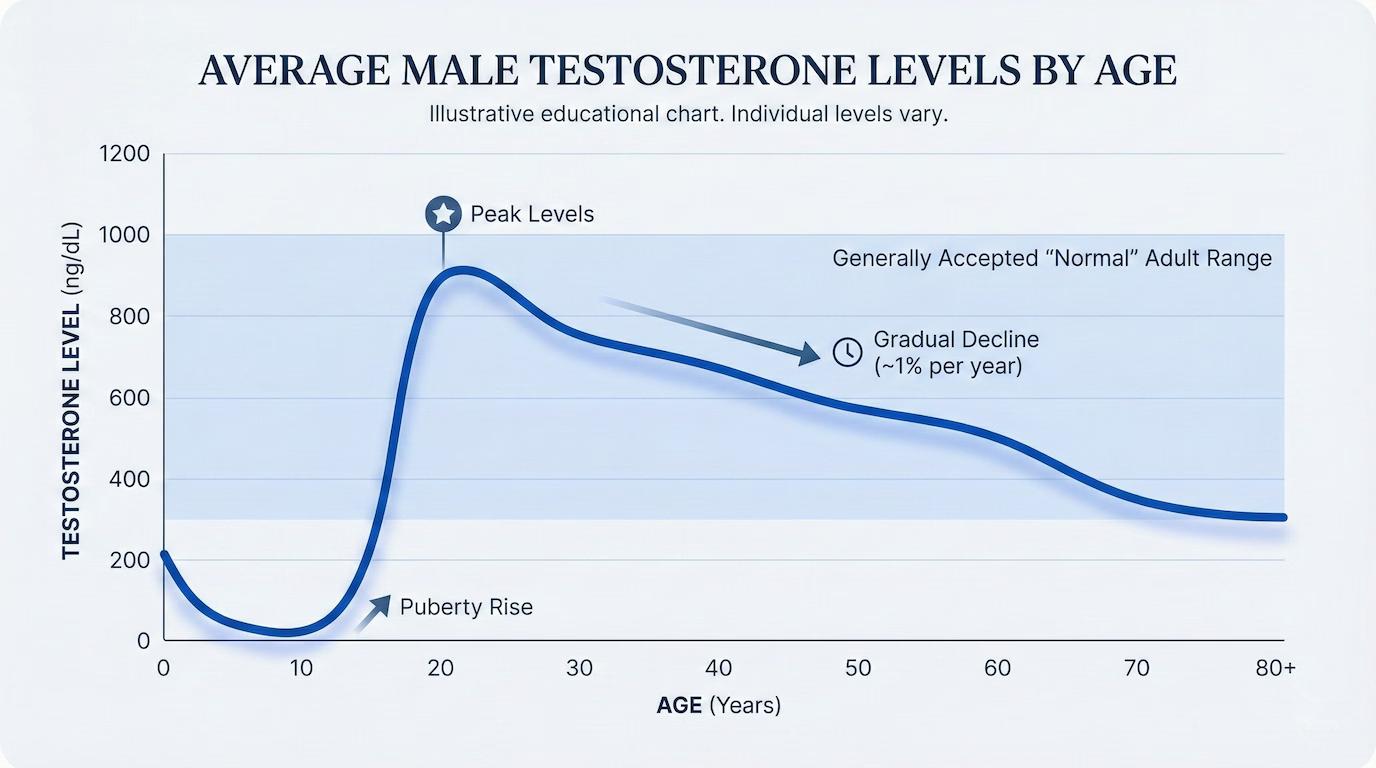
Testosterone doesn't follow a straight line through life. It surges, plateaus, and gradually declines in a pattern that's remarkably consistent across populations - though individual variation matters enormously.
The early years: Male fetuses actually produce testosterone in utero, driving the development of male reproductive organs. After birth, levels drop off dramatically and remain relatively low throughout childhood. This hormonal quiet period is essential for normal development.
Puberty's explosion: Between ages 10-14, testosterone production kicks into high gear. This surge—often increasing levels by 10 to 20 times—drives the familiar changes: voice deepening, muscle growth, body hair, and sexual maturation. It's not just physical. Testosterone shapes brain development during adolescence, influencing risk-taking behavior, competitive drive, and spatial reasoning.
Peak years (late teens to early 30s): Testosterone levels reach their lifetime high, typically between ages 18-25. Most men in this range have total testosterone between 600-900 ng/dL, with some reaching over 1,000 ng/dL naturally. Energy is abundant. Muscle builds easily. Recovery from workouts happens quickly. This is your hormonal prime.
The gradual decline (30s onward): Here's where it gets interesting. Starting around age 30, testosterone drops about 1% annually. Do the math: by age 50, you're potentially down 20% from your peak. By 70, it could be 40% or more. This isn't a cliff—it's a gentle slope. But over decades, that slope compounds.
For example, a 25-year-old with testosterone at 750 ng/dL might measure 600 ng/dL at 45 and 450 ng/dL at 65. He's technically still "in range" at all three ages, but he's lost 40% of his testosterone over four decades. That difference shows up in energy, body composition, sexual function, and mental sharpness.
The key insight: Age-related decline is natural, but it's not uniform. Lifestyle, health conditions, medications, and genetics all influence whether your testosterone follows the average trajectory or takes a steeper dive.
Testosterone Ranges By Age: Reference Charts and What They Actually Mean
Let's start with the definition: Total testosterone is the measurement of all testosterone in your bloodstream, including testosterone bound to proteins and the small percentage (about 2%) that's "free" and biologically active. It's typically measured in nanograms per deciliter (ng/dL) in the U.S. or nanomoles per liter (nmol/L) elsewhere.
Here are the generally accepted reference ranges for total testosterone in men by age group:
Notice those ranges are wide. A 45-year-old at 320 ng/dL is technically "normal," but he's at the bottom of the range. He might feel terrible—fatigued, unmotivated, struggling with weight—while his doctor says everything's fine.
This is where "optimal" becomes important. Being in range isn't the same as feeling good. Many men feel their best in the upper half of the reference range for their age. A level of 750 ng/dL typically feels very different from 350 ng/dL, even if both are technically normal.
Free testosterone matters too. Some men have adequate total testosterone but low free testosterone—the portion that actually does the work. Free testosterone should typically be above 9 ng/dL (or about 2% of total testosterone). If your total is 600 ng/dL but your free testosterone is only 6 ng/dL, that explains why you don't feel as good as the numbers suggest you should.
Lab reference ranges also vary by testing method and facility, so always compare your results to the specific reference range provided on your lab report. What matters most isn't comparing yourself to a chart—it's how you feel, how your levels have changed over time, and whether your symptoms align with what your numbers show.
Beyond Age: The Other Factors That Dramatically Impact Your Testosterone Levels
Age gets the blame for declining testosterone, but it's often the scapegoat for lifestyle factors that hit hard in middle age. Here are the real culprits that can tank your levels—regardless of what year you were born.
Body composition:
Excess body fat doesn't just correlate with low testosterone—it actively suppresses it. Fat tissue contains an enzyme called aromatase that converts testosterone into estrogen. The more fat you carry, especially around your midsection, the more testosterone you lose to conversion. Studies show obese men have testosterone levels 30-40% lower than lean men of the same age. For example, a 40-year-old at 25% body fat might have testosterone around 400 ng/dL, while his lean friend at 15% body fat measures 650 ng/dL.
Sleep quality and duration:
Testosterone production happens primarily during sleep, especially during REM cycles. Chronic sleep deprivation—getting less than 6 hours consistently—can drop testosterone by 10-15% in just one week. Night shift workers and people with untreated sleep apnea often have significantly suppressed levels.
Chronic stress:
When cortisol (your stress hormone) stays elevated, testosterone production suffers. It's a biological trade-off. Your body prioritizes survival over reproduction when it perceives constant threat. Men in high-stress jobs or dealing with ongoing personal crises often see testosterone drop 20-30% below their baseline.
Medications:
Opioid painkillers are notorious testosterone suppressors—even short-term use can halve your levels. Statins, antidepressants (especially SSRIs), and corticosteroids also impact testosterone. If you started a new medication and suddenly feel off, this might be why.
Alcohol consumption:
Heavy drinking (more than 2 drinks daily) impairs testosterone production in the testes and increases estrogen levels. Moderate drinking has minimal impact, but chronic excess can reduce testosterone by 20% or more.
Underlying health conditions:
Type 2 diabetes, metabolic syndrome, thyroid disorders, and chronic inflammatory conditions all correlate with lower testosterone. Diabetes, in particular, affects testosterone so consistently that some researchers consider it a near-guaranteed complication.
Here's the empowering part: unlike age, you can modify most of these factors. A 50-year-old who sleeps well, stays lean, manages stress, and exercises regularly can have higher testosterone than an unhealthy 30-year-old. Your biological age matters less than how you treat your biology.
Signs and Symptoms of Low Testosterone at Different Life Stages
Low testosterone doesn't announce itself with a single obvious symptom. It creeps in gradually, manifesting differently depending on your age and life circumstances.
In your 20s and 30s:
Low testosterone at this age is less common but more noticeable because you're supposed to be in your prime. Red flags include persistent difficulty building muscle despite consistent training, unexplained weight gain (particularly around the midsection), and lower libido than your peers. For example, a 28-year-old who lifts four times weekly but can't add muscle mass—and feels exhausted by 8 PM despite sleeping well—might be dealing with testosterone in the 300-400 ng/dL range when he should be at 700+. Morning erections become less frequent or disappear entirely. Mental fog and difficulty concentrating can appear, though these are often attributed to work stress.
In your 40s and 50s:
This is when symptoms get blamed on "normal aging," making them easy to dismiss. Watch for:
Energy crashes: Needing afternoon naps, struggling to finish workouts, losing the drive to pursue hobbies
Sexual changes: Reduced spontaneous desire, erectile difficulties, decreased satisfaction
Mood shifts: Increased irritability, mild depression, loss of competitive drive
Cognitive changes: Trouble with word recall, decreased mental sharpness, reduced problem-solving ability
A classic example: a 47-year-old who used to love playing weekend basketball now dreads it because recovery takes days instead of hours. His workouts feel harder, his results are diminishing, and he's wondering if he should just accept that his "best years are behind him." His testosterone has dropped from 680 ng/dL in his 30s to 380 ng/dL now—a significant decline that explains everything he's experiencing.
In your 60s and beyond:
Symptoms become more pronounced and overlap with other age-related changes. Decreased bone density becomes a concern (testosterone is protective), muscle loss accelerates (sarcopenia), and cardiovascular health may suffer. Fatigue can become debilitating rather than just annoying. Sexual function often declines significantly.
The challenge at any age: these symptoms are non-specific. They overlap with depression, thyroid problems, sleep disorders, and vitamin D deficiency. That's why testing is essential. You can't diagnose low testosterone by symptoms alone—but symptoms should prompt you to investigate.
When to Test Your Testosterone Levels (and How to Do It Right)
Getting tested seems straightforward—just walk into a lab, right? Not quite. Timing, testing method, and what you actually measure make a huge difference in whether your results are meaningful or misleading.
You're over 35 and want a baseline to track changes over time
You've had dramatic changes in energy, body composition, or sexual function
You have a condition associated with low testosterone (diabetes, obesity, sleep apnea)
You're considering testosterone therapy and need pre-treatment values
Timing is critical: Testosterone levels fluctuate throughout the day, peaking in the early morning and declining by 20-30% by afternoon. Always test between 7-10 AM to get accurate, comparable results. A reading of 450 ng/dL at 8 AM might be concerning, but that same 450 ng/dL at 4 PM actually suggests your morning level was probably 550-600 ng/dL—perfectly adequate.
For example, a 42-year-old tests his testosterone at 3 PM during a lunch break and gets 340 ng/dL. His doctor says he's low and suggests treatment. But had he tested at 8 AM, he likely would have measured 425-450 ng/dL—still low-normal, but possibly not requiring intervention.
Free testosterone: The bioavailable portion that actually matters
SHBG (sex hormone binding globulin): The protein that binds testosterone; high SHBG means less free testosterone
Estradiol: The primary estrogen; elevated levels cause side effects even if testosterone is adequate
LH and FSH: These reveal whether low testosterone is a testicular problem or a signaling problem from the brain
Testing methods matter: The liquid chromatography-mass spectrometry (LC-MS) method is the gold standard. Many labs use cheaper immunoassay tests that can be inaccurate, especially at lower levels. Specify LC-MS testing if possible.
Get retested: A single test is a snapshot. Testosterone levels can vary by 20% or more between tests due to stress, sleep, illness, or lab variation. If your first test shows borderline or low levels, retest 4-6 weeks later to confirm. Always use the same lab and same testing time for accurate comparison.
Your Testosterone Optimization Options: From Lifestyle Changes to Medical Protocols
Once you know your testosterone levels by age and confirm they're suboptimal, you have a spectrum of options - from completely natural approaches to medical intervention. Where you start depends on how low your levels are and how significantly they're affecting your life.
Lifestyle optimization (try this first):
Resistance training: Heavy compound lifts (squats, deadlifts, bench press) trigger testosterone production. Studies show consistent strength training can boost levels by 15-20%. Focus on progressive overload—lifting heavier weights over time matters more than endless high-rep workouts.
Body composition improvement: Losing excess fat—particularly visceral fat—is one of the most effective natural interventions. A 250-pound man at 30% body fat who drops to 200 pounds at 18% body fat can see testosterone rise 150-200 ng/dL from fat loss alone. That's significant. If you’re looking to make a transformation in 2026, learn more about our weight loss treatments.
Sleep optimization: Prioritize 7-9 hours of quality sleep. If you snore heavily or wake unrefreshed, get evaluated for sleep apnea—treating it can boost testosterone by 100+ ng/dL in some men.
Stress management: Find practices that genuinely reduce cortisol—meditation, nature time, therapy, or simply cutting out energy vampires from your life. This isn't woo-woo; it's biochemistry. Learn more about Maximus’ breakthrough Oxytocin Calming Cream for improving mood, sleep, and stress.
Nutrition: Adequate protein (0.8-1g per pound of body weight), healthy fats (especially saturated fat and omega-3s), and sufficient calories matter. Chronic dieting and low-fat diets suppress testosterone.
Natural supplements (modest benefits):
Vitamin D: If you're deficient (below 30 ng/mL), supplementing to optimal levels (50-70 ng/mL) can increase testosterone 20-30%
Zinc and Magnesium: Useful if deficient; limited benefit if you're already sufficient
Ashwagandha: Some studies show 10-15% increases in stressed individuals
For example, a 44-year-old at 420 ng/dL who loses 25 pounds, starts lifting three times weekly, fixes his sleep apnea, and optimizes vitamin D might reach 580 ng/dL without medical treatment. That's transformative.
If lifestyle changes don't sufficiently improve T levels, or if you're deficient (below 300 ng/dL) - Testosterone therapy becomes appropriate. Options include:
Injectable testosterone: Most effective; typically administered weekly or biweekly
Topical testosterone (Cream, Gels): Convenient but less consistent absorption
Oral testosterone: Implanted every 3-6 months; steady levels but invasive
TRT requires medical supervision, regular monitoring, and understanding trade-offs like fertility impacts and long-term commitment. But for men with high performance demands or genuinely low testosterone, it can be life-changing.
Special Considerations: Testosterone Levels in Women
Testosterone isn't just a male hormone—it's essential for women's health too. Women produce testosterone in their ovaries and adrenal glands, just in much smaller amounts than men. But "smaller" doesn't mean insignificant.
Normal testosterone ranges for women:
Adult women typically have total testosterone between 15-70 ng/dL—roughly one-tenth to one-twentieth of male levels. Free testosterone in women ranges from 0.5-6 ng/dL. These levels peak in a woman's 20s and decline gradually with age, dropping more dramatically after menopause when ovarian production decreases.
Why testosterone matters for women:
Libido and sexual function: Testosterone drives sexual desire in women just as it does in men
Bone density: Adequate testosterone helps maintain strong bones and prevent osteoporosis
Muscle mass and strength: Testosterone supports lean muscle development and metabolic health
Mood and energy: Low levels contribute to fatigue, depression, and lack of motivation
Cognitive function: Testosterone supports memory, focus, and mental clarity
Signs of low testosterone in women:
A 45-year-old woman in perimenopause notices her formerly healthy sex drive has vanished completely. She's also experiencing persistent fatigue despite adequate sleep, difficulty maintaining muscle despite regular exercise, and a general lack of zest for life. Her testosterone measures 12 ng/dL—below the normal range. Her doctor had only checked estrogen and thyroid, missing the testosterone component entirely.
Common causes of low testosterone in women:
Menopause (natural or surgical removal of ovaries)
Birth control pills (suppress natural hormone production)
Adrenal insufficiency
Chronic stress and cortisol elevation
Anorexia or extreme caloric restriction
Aging (gradual decline starting in the 30s)
Treatment considerations:
Women with confirmed low testosterone and bothersome symptoms may benefit from testosterone therapy, though it's less standardized than treatment for men. Options include low-dose testosterone creams, oral medications, or low-dose injections. The goal isn't to reach male levels - that causes side effects like facial hair growth, voice deepening, and clitoral enlargement. Instead, therapy aims to restore levels to the upper end of the female reference range.
Women's testosterone testing should also occur in the morning for consistency, include both total and free testosterone, and be interpreted in the context of symptoms rather than numbers alone. Many women feel dramatically better with even modest testosterone optimization.
The Bottom Line on T Levels
Understanding the reality of testosterone levels at your age isn't about chasing an arbitrary number or resisting the inevitable march of time. It's about recognizing when something feels genuinely off, getting objective data, and making informed decisions about your health.
Here's what matters: You don't have to accept feeling subpar as an unavoidable consequence of aging. Yes, testosterone declines naturally over time. But how steeply it declines—and how much that decline affects your quality of life—depends significantly on factors within your control.
Start with the fundamentals. Optimize your sleep. Build and maintain lean muscle mass. Manage stress deliberately rather than letting it manage you. Address any underlying health conditions sabotaging your hormones. These aren't trendy bio hacks—they're evidence-based strategies that work.
If lifestyle optimization isn't enough and your levels are genuinely low, medical intervention becomes a legitimate option. There's no virtue in suffering through fatigue, diminished mental sharpness, and reduced vitality when safe, effective treatments exist.
Your next steps:
If you're experiencing symptoms of low testosterone, get tested properly—early morning, comprehensive panel, using a reputable lab. Track your results over time. Work with a knowledgeable healthcare provider who treats symptoms and numbers together, not just one or the other.
Whether you're 25 or 65, your testosterone levels significantly influence how you feel, perform, and show up in life.
If you're experiencing symptoms of low testosterone or want to optimize for peak performance, Maximus offers science-backed testosterone therapy protocols to help you get there. Our programs include comprehensive testing, physician oversight, and ongoing monitoring—so you can optimize safely and effectively.