Magnesium can support better sleep quality by calming the nervous system, modulating GABA receptors, relaxing muscles, and helping your body shift out of “fight or flight” into “rest and digest.”
It won’t knock you out like a sedative, but in people who are low or borderline, correcting magnesium can reduce nighttime anxiety, restlessness, and cramps that interfere with deep, restorative sleep.
Magnesium glycinate is the go-to sleep form for most people, with magnesium threonate as a brain-focused option and magnesium malate playing a supporting role for daytime energy and recovery.
Most adults land around 200–400 mg of elemental magnesium in the evening (from diet plus supplements) for sleep support; dosing needs to account for what you’re already getting from products like Building Blocks.
Magnesium works best as part of a holistic sleep strategy—consistent schedule, light hygiene, training timing, and stress management—rather than as a standalone “sleep hack.”
Why Sleep Is the Ultimate Recovery Tool
Before we talk about magnesium, it’s worth zooming out to note that sleep is the backbone of recovery. If you’re training hard, optimizing hormones, or using GLP-1s to lose weight, the quality of your sleep largely determines how well those efforts translate into results.
Deep Sleep, REM, and Light Sleep—Why They Matter
A simplified view of sleep architecture:
Light sleep (N1/N2): Transition stages as you drift off; helps process some memories and information.
Deep sleep (slow-wave / N3): Heaviest, most restorative stage. This is where you see big pulses of growth hormone, tissue repair, and immune system maintenance.
REM sleep: Dream-heavy stage where your brain consolidates procedural and emotional memories; important for mood, learning, and nervous-system reset.
You cycle through these stages several times per night. Cutting sleep short—or constantly fragmenting it—means:
Less testosterone and growth hormone production
Worse insulin sensitivity and higher next-day blood sugar
Disrupted appetite hormones (ghrelin and leptin), making you hungrier and more snack-prone
Poorer muscle recovery, more soreness, and lower training output the next day
From a Maximus perspective, that means your testosterone protocol, GLP-1 plan, or training program is only as good as the sleep that backs it up.
Magnesium is not a replacement for good sleep habits, but it can help your body access deeper, calmer, more restorative sleep so the rest of your optimization stack actually pays off. For more on magnesium’s overall benefits beyond sleep, see our magnesium master guide.
How Magnesium Helps You Sleep
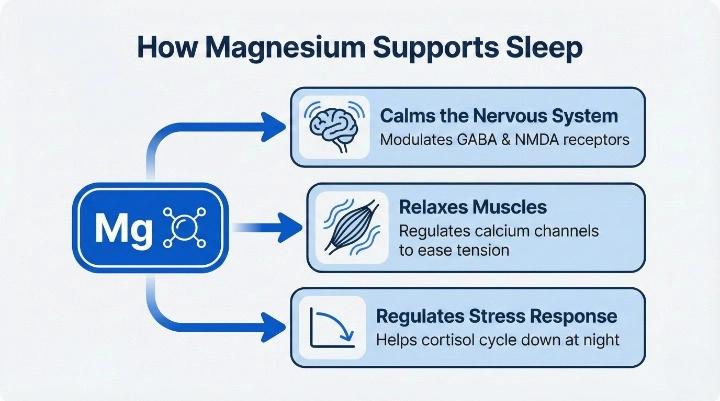
Calming the Nervous System
One of magnesium’s most important roles for sleep is nervous-system regulation.
Magnesium helps modulate GABA receptors, which are central to calming neuronal activity. GABA is essentially your brain’s “brake pedal.”
It also influences NMDA receptors, preventing excessive excitatory signaling that can keep you wired when you’re supposed to wind down.
By supporting this balance, magnesium makes it easier to shift from sympathetic “fight or flight” into parasympathetic “rest and digest.”
For a lot of people, the experience is subtle but noticeable: fewer racing thoughts, less “mind stuck in work mode,” and an easier slide into sleep—especially when combined with a consistent wind-down routine.
Relaxing Muscles and Easing Tension
Magnesium also acts at the muscular level:
It helps regulate calcium influx into muscle cells. Calcium triggers contraction; magnesium helps muscle fibers relax after they fire.
When magnesium is low, muscles may become more excitable, leading to twitches, cramps, or that “restless legs” feeling at night.
If you regularly go to bed feeling physically “keyed up”—tight hip flexors, clenched traps, calves that threaten to cramp at 2 a.m.—optimizing magnesium can be one lever that helps your body physically let go.
Cortisol & the Stress Response
Chronic stress and magnesium are locked in a two-way relationship:
Stress hormones increase urinary magnesium loss.
Lower magnesium, in turn, can make the nervous system more reactive to stress.
Over time, that can look like:
Feeling exhausted but unable to shut off at night
Waking up at 3–4 a.m. with a racing mind
Over-reacting to small stressors during the day
By restoring magnesium, you’re not “blocking cortisol,” but you are making it easier for your stress system to do its job and then stand down, instead of staying stuck in high alert.
Best Forms of Magnesium for Sleep
Not every magnesium supplement is built for sleep. The form you choose affects absorption, side effects, and how it feels in your body.
Magnesium Glycinate (Primary Sleep Form)
If you’re only going to pick one form for sleep, magnesium glycinate is usually it.
Magnesium is chelated (bound) to glycine, an amino acid that itself has calming and sleep-supportive properties.
It’s highly bioavailable and tends to be easy on the stomach, even at night.
Many people find it reduces “wired but tired” feelings and smooths the transition into sleep.
For individuals with insomnia, nighttime anxiety, or high-stress lifestyles, glycinate is typically our first-line sleep form.
Magnesium Threonate
Magnesium L-threonate is a more specialized option:
It’s designed to cross the blood–brain barrier more effectively.
Early research suggests potential benefits for cognition, mood, and age-related brain changes, though the data for pure sleep outcomes are still limited.
It’s usually more expensive and lower in elemental magnesium per capsule, so you’re paying for brain targeting rather than pure magnesium load.
Threonate can be a solid choice if your sleep issues are tightly tied to mental overactivity, focus, or brain fog—but for most people, glycinate is more than enough.
Magnesium Malate (Where It Still Fits)
Magnesium malate pairs magnesium with malic acid, a key player in the Krebs cycle and ATP production.
It shines earlier in the day for energy, performance, and recovery, especially in active people.
It’s the form we use in Building Blocks, so many Maximus clients already have a solid daytime magnesium base.
For sleep, we don’t typically rely on malate as the primary evening form. Instead, a common pattern is:
Daytime: Magnesium malate as part of Building Blocks for energy and metabolic support
Nighttime: A modest dose of glycinate layered on top (when appropriate and approved by your clinician)
Forms to Use Carefully for Sleep
Some forms are less ideal right before bed:
Magnesium citrate – Reasonably well absorbed but pulls water into the gut; good for occasional constipation, not so great if it sends you to the bathroom at 2 a.m.
Magnesium oxide – High in elemental magnesium but poorly absorbed; mostly acts as a laxative rather than repleting magnesium in your cells.
For a full rundown of different magnesium forms and when to use them, see our guide to types of magnesium.
How Much Magnesium Should You Take for Sleep?
Typical Sleep-Supportive Doses
The official RDAs for magnesium are roughly:
Men: 400–420 mg/day
Women: 310–320 mg/day
Those numbers cover total daily intake from food and supplements, not just what you take at night.
For sleep support, many adults end up in the range of:
~200–400 mg of elemental magnesium in the evening, counting both diet and supplements.
If you’re using Building Blocks, you already get 200 mg of highly bioavailable magnesium malate during the day. In that case, some people only need a modest additional evening dose (e.g., 100–200 mg of glycinate) to support sleep—rather than pushing toward the top end with multiple products.
Titrating Your Dose
Magnesium is not “more is always better.” A smart approach:
Add up your total intake from diet and all supplements (including multivitamins, pre-workouts, and “nighttime calm” products).
Start low on any new evening magnesium—often 100–150 mg elemental—and see how your body responds over 5–7 nights.
If you tolerate it well but still feel you’re not getting benefit, you and your clinician may decide to gradually increase toward the upper end of your target range.
Signs you’ve gone too high:
Loose stools or diarrhea
Stomach cramping or nausea
Needing to get up to use the bathroom more than usual at night
The tolerable upper intake level (UL) for supplemental magnesium from non-food sources is 350 mg/day for adults, primarily to avoid GI side effects. Food-derived magnesium doesn’t count toward this limit.
Safety note: People with kidney disease, significant renal impairment, or on medications that affect electrolytes must talk to their healthcare provider before adding magnesium supplements. Pregnant and breastfeeding individuals should also work with their clinician to tailor dosing.
Best Time to Take Magnesium for Sleep & Recovery
60–90 Minutes Before Bed
For most people, the sweet spot is about 60–90 minutes before your target bedtime.
That window gives your gut time to absorb the magnesium.
It lines up well with the start of your wind-down routine: dimming lights, shutting screens down, and letting your brain exit work mode.
You don’t need second-by-second precision; consistency matters more than hitting an exact timestamp.
Stack It With Other Sleep Rituals
Magnesium works best when it’s part of a sleep ecosystem, not a lone supplement tossed into chaos.
Good pairings:
Keeping a consistent sleep and wake time, even on weekends
Reducing bright/blue light for 60–90 minutes before bed
Keeping the room cool, quiet, and dark
Light stretching, foam rolling, or a hot shower to prime muscle relaxation
Short breathing exercises, meditation, or journaling to close out the day
Magnesium can help your nervous system say “yes” to those cues—but it can’t overcome triple espressos at 7 p.m. and doom-scrolling in bed.
Magnesium for Nighttime Recovery in Athletes
For athletes and lifters, nighttime magnesium pulls double duty:
Muscle relaxation: Less cramping and tightness makes it easier to relax physically.
Recovery: Better sleep quality supports growth hormone release, testosterone recovery, and muscle protein synthesis.
Consistency: When you sleep better, you’re more likely to train consistently, add volume intelligently, and avoid burnout.
You’re using a GLP-1 weight loss protocol and your new eating patterns or rapid fat loss are affecting sleep and recovery.
If your biggest issue is daytime anxiety or persistent stress more than sleep itself, magnesium can still be helpful—but the priority may be how it fits into an overall stress improvement plan. Read more about magnesium for anxiety & stress to explore this use case deeper.
Where Magnesium Fits in a Holistic Sleep Strategy
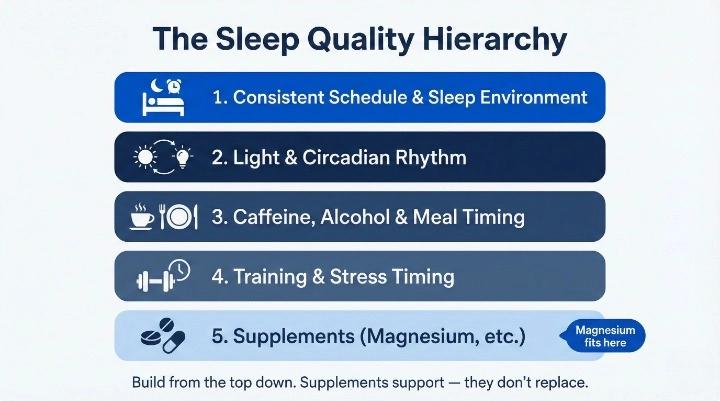
It’s easy to put supplements on a pedestal. In reality, sleep quality is built from the ground up.
A reasonable hierarchy:
Regular schedule & sleep environment
Consistent bed/wake times
Cool, dark, quiet room
Light and circadian rhythm
Bright light in the morning
Low light, especially blue light, in the evening
Caffeine, alcohol, and heavy meals
Limiting caffeine after early afternoon
Avoiding heavy, late-night meals and excess alcohol
Training and stress timing
Earlier-day intense sessions when possible
Downshifting stress before bed
Supplements like magnesium (and others as your clinician recommends)
Magnesium belongs at step 5: a low-risk, high-upside foundation that fills in micronutrient gaps and helps your nervous system respond to the other habits you’re putting in place.
Building Blocks includes magnesium malate as part of a complete performance multivitamin for people on Maximus protocols. For those whose main bottleneck is sleep, many clients work with their Maximus clinician to layer an evening magnesium glycinate on top—so daytime energy, training, and hormonal optimization are all backed by deep, consistent rest.
FAQs
Does magnesium really help you sleep?
For many people, yes—especially if they’re not getting enough magnesium from diet alone. Studies in older adults and people with insomnia symptoms show that magnesium supplementation can modestly improve sleep quality, sleep efficiency, and how long it takes to fall asleep, though it’s not a knockout drug and results vary.
Think of it as removing a biochemical bottleneck so your brain and body can respond better to the sleep cues you’re already giving them.
What is the best magnesium for sleep?
For most people, magnesium glycinate is the best starting point—highly bioavailable, gentle on the gut, and naturally calming. Magnesium threonate is a good option if your sleep issues are tied to cognition and “brain noise,” while magnesium malate is better suited for daytime energy and recovery rather than primary sleep support.
How long does it take for magnesium to improve sleep?
Some people notice changes within a few nights—especially reduction in cramps or a smoother transition to sleep. For others, it may take 2–4 weeks of consistent use to feel the full effects as overall magnesium status improves. It’s not an immediate sedative; it’s more of a gradual recalibration of your nervous system and muscles.
Can I take magnesium every night?
Most healthy adults can take magnesium nightly within recommended doses, especially when they account for total daily intake and choose well-tolerated forms. The key is to:
Stay around your recommended daily intake (from food + supplements)
Watch for GI side effects
Talk with your clinician if you have kidney disease, are on medications that affect electrolytes, or are pregnant/breastfeeding
Is magnesium enough to improve my insomnia?
Magnesium can be a valuable part of an insomnia plan, particularly if stress, muscle tension, or suboptimal magnesium intake are in the mix. But chronic or severe insomnia often has multiple contributing factors—behavioral, psychological, medical—that require a more comprehensive approach, sometimes including cognitive behavioral therapy for insomnia (CBT-I) or other medical treatments. If you’re regularly struggling to sleep or your symptoms are worsening, it’s important to speak with a healthcare professional.