Types of Magnesium: Best Form for Sleep, Stress, Energy, and Performance
Key Takeaways
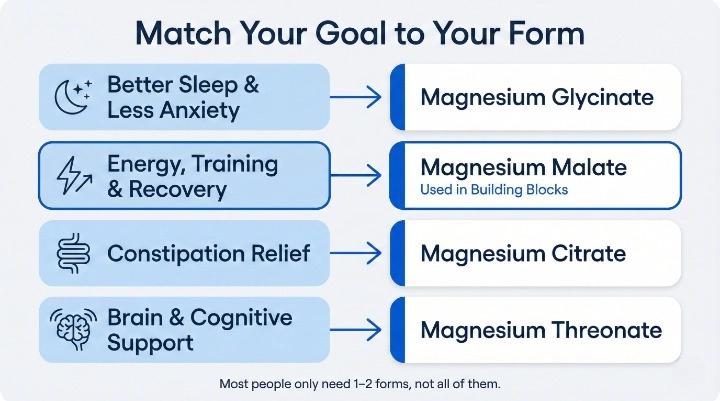
Most people don’t need every type of magnesium—you want the form that matches your goal: sleep/stress (glycinate), energy/performance (malate), brain-focused support (threonate).
Magnesium oxide is usually a poor choice for repleting magnesium because it’s poorly absorbed and behaves more like a laxative than a performance supplement.
If you’re on GLP-1 therapy, prioritize forms with better GI tolerance (malate, glycinate) and be cautious with citrate/oxide if you’re already dealing with nausea, diarrhea, or stomach sensitivity.
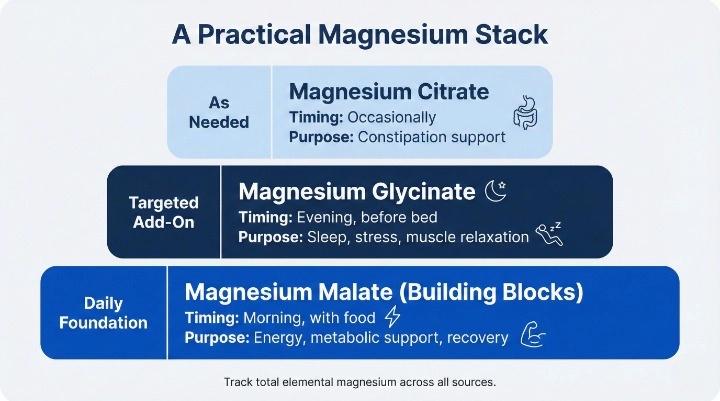
A smart “stack” for many Maximus clients is a foundational base (malate) + a targeted add-on (glycinate at night). Instead of chasing hype forms.
Why There Are So Many Types of Magnesium
Magnesium is the mineral your body uses for hundreds of enzyme reactions—energy production (ATP), muscle function, nervous system regulation, and metabolic health. But in supplements, magnesium doesn’t usually exist “alone.” It’s bound to another molecule (a salt or chelate), and that partner changes how the magnesium behaves.
Different forms mainly affect:
Absorption: How much magnesium you actually take up from the gut
GI tolerance: Whether it’s gentle or whether it pulls water into the intestines (hello, loose stools)
Functional “feel”: Some forms trend more calming, others more energizing, mostly due to the partner molecule and dosing timing
Tissue targeting (sometimes): A few forms are designed to influence brain levels more directly
More forms doesn’t mean you need all of them. It just means you can choose the one that fits your goal.
Quick Comparison: Best Types of Magnesium at a Glance
Use this fast picker to choose a form based on your goal. Then scroll for the deeper breakdowns.
If your main goal is sleep or nighttime calm
Magnesium glycinate → Best all-around for sleep, stress, muscle tension; usually gentle on the stomach.
Magnesium threonate → More “brain-focused” option; tends to be pricier and often lower in elemental magnesium per capsule.
If your main goal is daytime energy, training performance, or recovery
Magnesium malate → Strong daytime form; performance-oriented and generally well tolerated. (This is the form we use in Building Blocks.)
Magnesium chloride → Solid general-purpose option; can work well, but tolerance varies with dose.
If your goal is relaxation routines (not deficiency correction)
Magnesium sulfate (Epsom salt baths) → Great for a wind-down ritual and soreness; absorption is variable, so don’t rely on it to fix low magnesium.
Quick rule of thumb (most people)
Daytime foundation: magnesium malate
Nighttime support (if needed): magnesium glycinate
Deep-Dive on the Most Common Forms
Magnesium Glycinate
What it is: Magnesium bound to glycine, an amino acid with calming properties.
Best for:
Sleep quality and easier sleep onset
Nighttime anxiety or “wired but tired” feeling
Muscle tension and tightness that disrupts sleep
Pros:
High bioavailability
Usually very gentle on the stomach
Works well as an evening magnesium
Cons:
Not the best choice if you want a “daytime energy” feel
What it is: Magnesium bound to malic acid, a compound involved in the Krebs cycle (energy production).
Best for:
Daytime energy, training performance, and recovery
General optimization (especially for active, high-output lifestyles)
People who want a daily form that supports ATP production without wrecking their gut
Pros:
Generally well absorbed
Often well tolerated at meaningful doses
Great fit for performance + metabolic support
Cons:
Some people find it mildly energizing if taken too late in the evening
This is the form we use in Building Blocks, because it’s a strong “daily driver” that supports energy, muscle function, and metabolic health with high tolerability—especially for active people and those on GLP-1 protocols.
Short-term “reset” when stools are hard or infrequent
Pros:
Widely available
Often effective quickly for bowel motility
Cons:
More likely to cause loose stools or diarrhea
Not ideal if you already have GI sensitivity or loose stools
Can be a bad fit for many GLP-1 users who already experience nausea or GI disruption
If constipation is the goal, citrate can be useful—but it should be used intentionally, not as your default “daily magnesium” forever.
Magnesium Oxide
What it is: Magnesium bound to oxygen (inorganic salt). Very common in cheap supplements.
Best for:
Constipation (because it functions as an osmotic laxative)
Not great for:
Repleting magnesium status
Performance, recovery, sleep optimization
Why: Magnesium oxide is poorly absorbed compared with many organic salts and chelates. It tends to stay in the GI tract and pull water into the bowel—so it can “work,” but mostly as a laxative.
We generally don’t recommend magnesium oxide as your primary magnesium supplement if your goal is systemic magnesium support.
Magnesium Threonate
What it is: Magnesium L-threonate, a form designed to increase magnesium levels in the brain.
Why Maximus Uses Magnesium Malate in Building Blocks
Our criteria for a foundational magnesium form are simple:
High bioavailability
Performance and energy support
GI tolerance for daily use
Fits well for active people and for those on GLP-1 protocols
Magnesium malate checks those boxes and aligns with our broader philosophy: Build the biochemical foundation first, then layer targeted support only where needed.
That’s why Building Blocks uses malate as the backbone, while acknowledging that some patients may benefit from a targeted glycinate add-on for sleep or stress support.
Can You Combine Different Types of Magnesium?
Yes, but do it deliberately.
Key rules:
Total elemental magnesium matters more than the number of bottles
Don’t stack multiple products without knowing how much magnesium you’re actually taking
If you get loose stools, you’ve probably overshot your tolerance or chosen the wrong form
A practical example stack:
Baseline: Building Blocks (malate) daily
Add-on (if needed): small nightly glycinate for sleep
Occasional: low-dose citrate for constipation as needed, not as a daily habit
And as always: if you’re on medications or have kidney disease, consult your clinician before combining forms or increasing dose.
FAQs about Magnesium Types
Can I take more than one type of magnesium at the same time?
Yes. Many people do best with a foundational form (like malate) plus a targeted form (like glycinate at night). Just track your total intake and avoid stacking mindlessly.
What’s the safest daily dose of magnesium from all sources?
Most adults aim for roughly 310–420 mg/day total (food + supplements), depending on sex and age. Higher total intakes are common in active people, but supplemental magnesium can cause GI side effects and should be individualized—especially if you have kidney issues or take medications.
Can I switch from one form of magnesium to another suddenly?
Yes, most people can switch forms without issues. The main thing to watch is GI tolerance. If you move from a gentler form (glycinate) to one more laxative (citrate), start low and increase gradually.
Which type of magnesium is best if I’m on GLP-1 medication?
Most GLP-1 users do best with well-tolerated forms like malate (daily foundation) and glycinate (nighttime sleep/stress support). Be cautious with citrate and avoid oxide-heavy products if you already have GI side effects.