Magnesium Malate: Uses, Benefits, Dosage & Why We Use It
Key Takeaways
Magnesium malate is magnesium bound to malic acid, a compound involved in cellular energy (ATP) production—making it a strong “daytime” magnesium for performance and fatigue support.
Compared with budget forms like magnesium oxide, malate is generally better suited for systemic magnesium support and daily use (less “cheap laxative,” more “repletion + performance”).
If your main goal is sleep or anxiety relief, magnesium glycinate is often the better specialist form—while malate works best as a foundational base you can build on.
Most people do best taking magnesium malate in the morning or early afternoon, especially if they find it slightly energizing.
Evidence for magnesium + malic acid in fibromyalgia exists but is mixed, so it’s best viewed as “may help some people” and should be clinician-guided.
What Is Magnesium Malate?
Magnesium malate is simply magnesium bound to malic acid.
Magnesium is an essential mineral used across hundreds of enzyme systems—muscle contraction and relaxation, nerve signaling, blood sugar regulation, and more. Malic acid (malate) is a naturally occurring compound found in foods (think apples) and, more importantly, it functions as part of your body’s energy-production machinery.
A quick Krebs-cycle translation into human-speak: malate is one of the “gears” in your cells’ engine. It helps your mitochondria convert fuel into usable energy (ATP). Pairing malate with magnesium creates a form that tends to make the most sense for people who want sustainable energy and performance support, not sedation.
If you want the full magnesium 101 (benefits, deficiency, dosing, and forms), start with our hub guide.
Key Benefits of Magnesium Malate
People don’t take magnesium malate because it sounds fancy. They take it because they want outcomes that matter in real life: more stable energy, better training performance, less “crash,” smoother recovery.
Energy, Fatigue & Daytime Performance
Magnesium is required for energy metabolism, and in the body ATP typically exists as Mg-ATP (ATP bound to magnesium) before it can be used by enzymes. That’s one reason low magnesium can feel like “everything takes more effort.” (Office of Dietary Supplements)
Magnesium malate adds a second layer: malate’s role in mitochondrial energy pathways. This doesn’t mean you’ll feel an immediate pre-workout “buzz.” The better expectation is:
fewer energy dips
less “wired and tired”
more consistent output during long days (work + training + family)
Magnesium supports normal muscle function by helping regulate contraction and relaxation—partly through its relationship with calcium movement in muscle cells. When magnesium is low, muscles can become more excitable, which can show up as tightness, twitching, or cramps.
Malate’s contribution here is best thought of as an “energy support” layer: recovery is energetically expensive. Repairing tissue, restoring glycogen, and returning your nervous system to baseline all require ATP.
Some people also search magnesium malate specifically for muscle pain or fibromyalgia. There is research on magnesium + malic acid in fibromyalgia, but the overall evidence is not a slam dunk—it’s mixed, with limited high-quality data. (medwave.cl)
Magnesium malate is not primarily marketed as a “brain form” (that’s more often magnesium threonate). Still, it can influence how you feel mentally in indirect but meaningful ways:
less fatigue and fewer energy crashes
better training consistency (which supports mood and stress resilience)
fewer cramps/tension that disrupt sleep
Some people also report improved mental clarity—likely because fatigue is lower and basic physiology is better supported, not because malate is a magic nootropic.
If mood and sleep are the main goals, you’ll likely get more direct benefit from these guides:
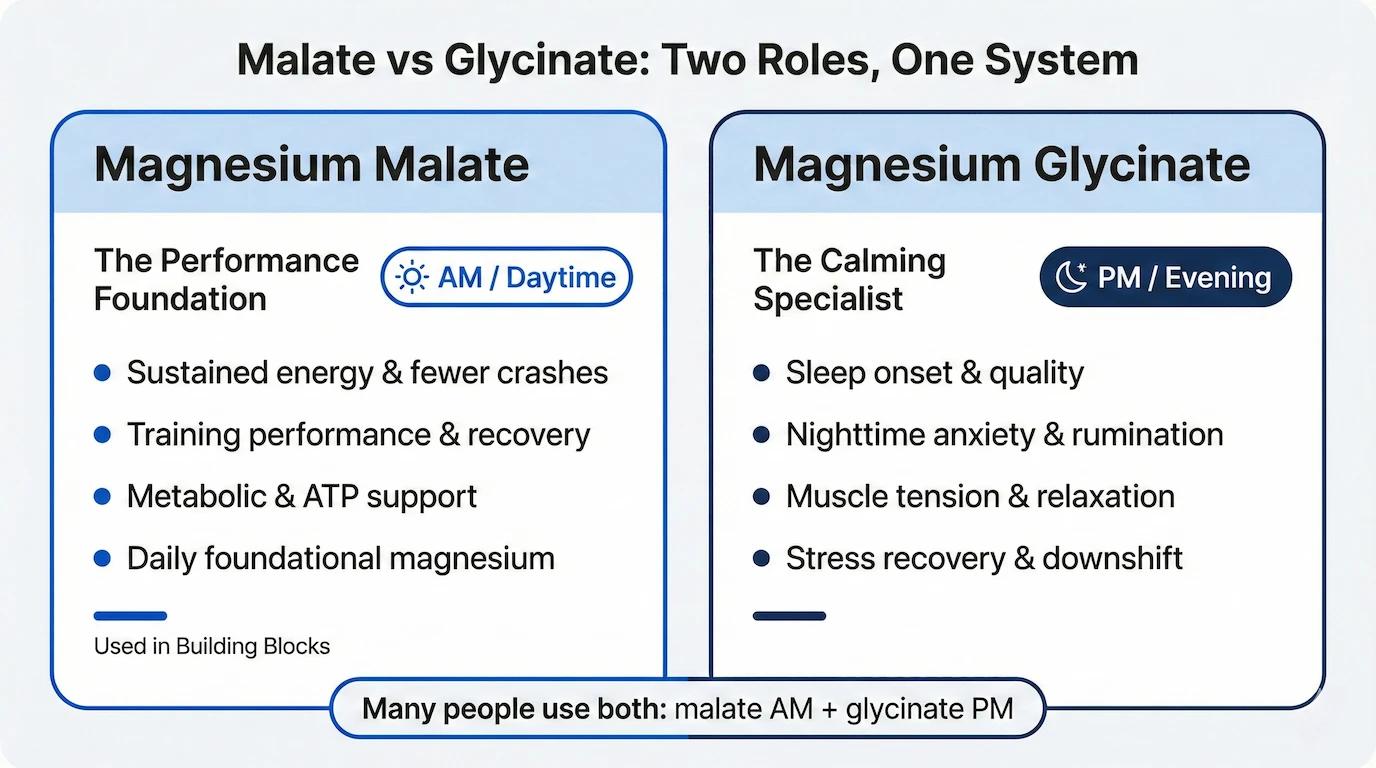
Magnesium malate = performance foundation (daytime energy, training support, recovery)
When malate is usually better:
you want daytime energy without stimulant dependence
you train regularly and care about recovery capacity
you’re covering a foundational magnesium base
When glycinate is worth layering on:
sleep onset is hard
nighttime rumination is high
anxiety/stress is a primary limiter, even after you’ve covered baseline magnesium
Magnesium Malate vs Citrate
Magnesium citrate’s “superpower” is constipation relief. It tends to draw water into the gut, which can be useful when that’s the goal—but less useful when you’re trying to build a daily routine you can stick with.
Citrate is often best used strategically (constipation-focused).
Malate is often better for systemic support, because many people tolerate it well without the same GI urgency.
For GLP-1 users or anyone with GI sensitivity, malate is typically the safer daily bet, while citrate is something you use intentionally (and carefully).
Magnesium Malate vs Oxide and Other Low-Quality Forms
Magnesium oxide is everywhere because it’s cheap and packs a lot of “elemental magnesium” per pill. The tradeoff is that it’s commonly considered less favorable for absorption than many organic forms, and it often behaves more like a laxative than a true repletion strategy. (ScienceDirect)
This matters for Maximus’ positioning: we’re not building a “consumer-grade” multivitamin that checks boxes on a label. We’re building a performance-focused foundation where form and tolerability actually determine whether people feel better and stick with it.
People on a GLP-1 program who want help preserving muscle and minimizing low-energy days during a deficit
“Desk athletes” (busy professionals) who want more stable energy and fewer crashes without piling on caffeine
People with fibromyalgia or chronic muscle pain who are exploring options with their clinician (set expectations realistically; evidence is mixed) (medwave.cl)
Soft reality check: if your primary issue is sleep or anxiety, malate can still be your base, but you may do better layering in a calming specialist form (like glycinate) rather than trying to make malate do everything.
This is exactly why Building Blocks uses magnesium malate at a performance-relevant dose—to cover the “foundation” daily without relying on stimulant crutches.
Dosage, Timing & How to Take Magnesium Malate
Typical Dosage Ranges
Magnesium dosing can get confusing because supplement labels list both:
the compound amount (e.g., “magnesium malate 1,000 mg”), and
the actual elemental magnesium amount (the magnesium itself)
For most healthy adults, the recommended magnesium intakes are in the range of a few hundred mg/day (from food + supplements). The NIH ODS fact sheet is a solid reference point for recommended intakes and safety considerations. (Office of Dietary Supplements)
A practical approach:
build toward meeting your daily magnesium needs through food first
then use supplements to close the gap based on symptoms, training, and tolerance
If you’re taking Building Blocks, you’re already getting a foundational dose of magnesium malate. If you add another magnesium product on top, track your total elemental magnesium so you don’t accidentally stack to the point where GI side effects take over.
Fibromyalgia note: some studies have used magnesium + malic acid combinations, sometimes at higher intakes, but this is where clinician guidance matters because the evidence is mixed and dosing can vary. (medwave.cl)
Best Time to Take Magnesium Malate
Because some people find malate slightly energizing, daytime tends to be best:
morning with breakfast
or split between morning and early afternoon
When not to take it:
right before bed, if you notice it makes you more alert
If sleep is a priority, it’s common to use malate as your daytime base and then discuss with your clinician whether a small evening glycinate dose makes sense.
How to Combine Malate with Other Supplements
If you want a clean “performance foundation” stack:
Building Blocks (malate base) daily
Adequate protein + creatine (if tolerated)
Reasonable sodium/potassium intake around training
A sleep plan that doesn’t rely on stimulants to compensate for bad nights
Magnesium doesn’t replace fundamentals, but it makes the fundamentals work better when you remove a micronutrient bottleneck.
Side Effects, Safety & Who Should Be Cautious
Magnesium malate is generally well tolerated, but dose and context matter.
Common side effects:
loose stools (usually dose-related)
mild GI discomfort if you increase too quickly
How to reduce issues:
take with food
start lower and titrate up
avoid stacking multiple magnesium products without tracking totals
People who should get medical clearance first:
those with kidney disease or impaired renal function (magnesium clearance depends heavily on kidneys) (Office of Dietary Supplements)
people with significant cardiac rhythm issues
anyone on medications with known magnesium interaction risks (certain antibiotics, bisphosphonates, and others—timing can matter) (Office of Dietary Supplements)
Reminder: this article is educational and not medical advice. If you’re on prescriptions or managing chronic conditions, talk to a clinician before changing supplements.
How Magnesium Malate Fits into Maximus Protocols
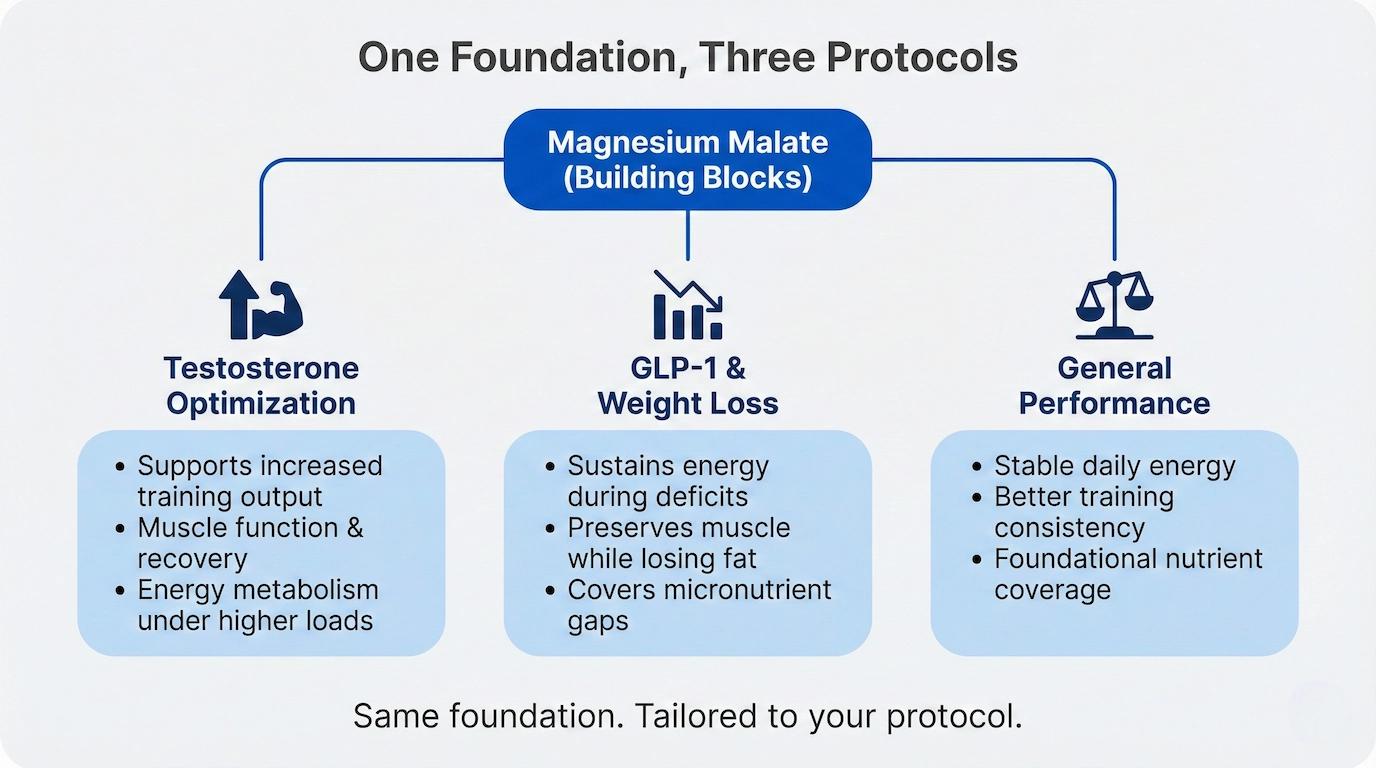
Magnesium malate is a “make the whole system work better” nutrient—exactly the kind of foundational lever that fits into our optimization approach.
Testosterone optimization:
Testosterone therapy often increases training output and recovery demands. Magnesium supports normal muscle function and energy metabolism so patients can better capitalize on their protocol.
GLP-1 & weight loss:
Calorie deficits can create low-energy days and increase the importance of micronutrient coverage. Magnesium malate helps support energy metabolism and muscle preservation when paired with protein and resistance training.
General performance & longevity:
In Building Blocks, magnesium malate works alongside other core nutrients to create a reliable base—so your training, sleep habits, and medical protocols aren’t built on nutritional gaps.
If you’re unsure whether magnesium malate (or Building Blocks overall) is a fit for your plan, the right move is to talk with a clinician who can evaluate your symptoms, diet, labs, and goals.
FAQs about Magnesium Malate
What is magnesium malate good for compared to other forms?
Magnesium malate is best known as a daytime, performance-oriented magnesium form. It supports energy metabolism and training recovery and is often better tolerated than laxative-leaning forms. If your main goal is sleep or anxiety, glycinate is often the better specialist.
Can I take magnesium malate at night, or will it keep me awake?
Some people tolerate it fine at night, but others find it mildly energizing. If you notice more alertness, take it earlier in the day and consider an evening-focused form (like glycinate) for nighttime support.
Can I combine magnesium malate with magnesium glycinate?
Yes—many people use malate as the daytime foundation and glycinate in the evening for sleep or stress support. The key is tracking total elemental magnesium and adjusting based on GI tolerance and your clinician’s guidance.
How long does it take to feel the benefits of magnesium malate?
Some people notice changes in muscle tension or energy within a week, especially if they were low on magnesium. More stable improvements (training consistency, fatigue resilience) often take a few weeks of consistent use and work best alongside sleep, nutrition, and training.
Is magnesium malate safe to take every day long-term?
For most healthy adults, magnesium supplements are generally safe within reasonable total intake ranges. People with kidney disease, significant medical conditions, or those on interacting medications should discuss magnesium use with a clinician first.