Magnesium for Muscle Growth & Recovery: Benefits, Timing & Best Forms
Key Takeaways
Magnesium is required for ATP production, muscle contraction and relaxation, and protein synthesis—making it foundational infrastructure for strength training and body recomposition.
Hard training, sweat loss, stress, and calorie restriction all increase magnesium demand, so lifters, athletes, and people on hormone or GLP-1 protocols are more likely to benefit from optimization—not just avoiding deficiency.
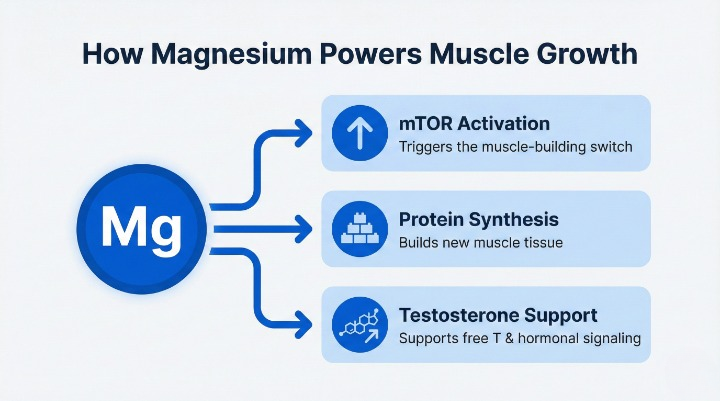
Magnesium supports muscle growth by enabling mTOR signaling, protein synthesis, and healthy testosterone biology, and supports recovery by regulating cramps, ATP regeneration, and sleep quality.
Magnesium malate is a top choice for performance: it’s well absorbed and pairs magnesium with malic acid, a Krebs-cycle intermediate that directly supports cellular energy production—one reason it’s the form used in Maximus Building Blocks.
Most active adults land in the 400–500 mg/day total magnesium range (food + supplements); doses above the standard 350 mg/day supplemental UL should be individualized with a clinician, especially if you have kidney issues or take medications.
Magnesium doesn’t give you the immediate buzz of a pre-workout or the visible pump of a nitric-oxide booster—but if it’s low, almost everything about your training and recovery feels worse.
This mineral is involved in more than 300 enzyme systems, including those that generate ATP, regulate calcium channels in muscle, and synthesize new proteins after training. For lifters, athletes, and anyone on a testosterone or GLP-1 protocol, magnesium is less of a “nice-to-have supplement” and more of a core performance nutrient.
In our master magnesium guide, we cover the big picture. Here, we’re zooming in on one question: how do you use magnesium specifically to support muscle growth and recovery?
Why Magnesium Matters for Muscle Performance
Magnesium’s role in muscle performance starts with energy production and extends all the way through contraction, relaxation, and nervous-system control.
It is required to convert food into ATP, the energy currency that powers every rep. Almost all ATP in cells exists as Mg-ATP—ATP bound to magnesium—before it can be used by enzymes.
Intense exercise increases ATP turnover, sweat loss, and urinary magnesium excretion, which collectively raise magnesium needs in athletes and heavy lifters.
Magnesium helps regulate calcium flow into and out of muscle cells, which is central to contraction and relaxation. When levels are low, muscles can become more excitable and prone to tightness or cramping.
From a performance standpoint, being marginally low in magnesium can show up as:
Slower recovery between sets
More frequent or more intense cramps and spasms
“Heavy” legs or an unusual sense of fatigue at workloads that used to feel easy
Poorer sleep after hard training days, which compounds fatigue further
That’s why magnesium sits alongside protein, sleep, and progressive overload as part of the baseline environment that makes your training productive.
For a broader overview of magnesium’s roles beyond the gym, see why magnesium matters.
How Magnesium Supports Muscle Growth
Muscle growth isn’t just “tear it down in the gym, build it back bigger.” It’s a tightly regulated biochemical process—and magnesium is involved at several key checkpoints.
1. Magnesium Helps Activate mTOR, the Muscle-Building Switch
mTOR (mechanistic target of rapamycin) is one of the major anabolic “switches” in muscle cells. It integrates signals from:
Mechanical tension (lifting)
Amino acids (especially leucine)
Hormones and growth factors
Most of that signaling ultimately relies on magnesium-dependent enzymes. Without adequate magnesium, the cascade that turns training and protein intake into new muscle tissue becomes less efficient.
2. Magnesium Enables Protein Synthesis
The ribosomes that actually assemble amino acids into new proteins are magnesium-dependent structures. Magnesium helps stabilize RNA and the ribosomal machinery, allowing your body to translate the protein you eat into actual contractile tissue.
That doesn’t mean magnesium alone builds muscle—but if you’re under-fueling, sleeping poorly, and running on low magnesium, the return on your training investment drops.
Magnesium also intersects with testosterone, especially in active men:
Observational work links higher magnesium status with higher total and free testosterone.
Experimental studies suggest magnesium may influence how testosterone binds to sex hormone–binding globulin (SHBG), potentially supporting higher free (bioavailable) testosterone in certain conditions—especially when combined with exercise.
Again, this is not a replacement for a testosterone optimization protocol when that’s medically indicated. But if you’re working with Maximus on hormone optimization, it makes little sense to neglect a mineral that participates in energy production, protein synthesis, and hormonal signaling.
How Magnesium Enhances Muscle Recovery
Recovery is where the gains actually happen. Magnesium supports that process on multiple fronts.
1. Regulating Cramps, Tightness, and Spasms
Magnesium’s role in calcium channel regulation makes it central to how smoothly muscles can contract and relax.
Low magnesium can lead to hyper-excitable nerves and muscle fibers, which shows up as twitches, tight calves at night, or mid-workout cramps.
Magnesium supplements are heavily marketed for cramps; large reviews (including Cochrane) suggest the evidence is mixed overall, but some subgroups—like people who are clearly deficient—may benefit.
The takeaway: magnesium isn’t a magic anti-cramp drug, but ensuring you’re not deficient is a low-risk way to reduce one more barrier between you and good training sessions.
2. Supporting ATP Regeneration After Training
Hard sets deplete ATP and phosphocreatine. While creatine gets most of the spotlight, magnesium:
Is required for the enzymes that rebuild ATP during and after exercise
Helps mitochondria run the Krebs cycle and oxidative phosphorylation efficiently, especially when paired with malate and other organic acids
If magnesium is low, your cell’s ability to re-synthesize ATP is compromised. Subjectively, that can feel like slower between-set recovery and a tendency to gas out early.
Sleep is the ultimate recovery tool. Magnesium can support sleep via:
Modulating GABA and NMDA receptors
Helping reduce hyper-arousal and stress physiology
Facilitating a smoother transition into parasympathetic, “rest-and-repair” mode
Systematic reviews in older adults and people with insomnia symptoms show modest improvements in sleep onset latency and subjective sleep quality with magnesium supplementation, though the data are not uniformly positive.
Better sleep means:
More growth hormone pulses
Better testosterone recovery
Improved muscle protein synthesis overnight
For a deeper dive on the sleep side, see our dedicated article on magnesium for sleep.
The Best Magnesium Forms for Muscle Growth & Recovery
Not all magnesium supplements behave the same. The form determines how well you absorb it, what it does in the gut, and how it feels in your body.
Magnesium Malate – Best All-Around for Performance & Recovery
Magnesium malate pairs magnesium with malic acid, a key intermediate in the Krebs cycle. This combination:
Is generally well absorbed compared with inorganic forms like oxide
Provides malate, which directly supports mitochondrial ATP production
Tends to be better tolerated at performance-oriented doses, with less GI upset
For people who:
Lift regularly
Do conditioning or sport practice
Are on testosterone or GLP-1 protocols and care about preserving muscle
…magnesium malate is a logical choice. It’s why we use magnesium malate as the magnesium source in Building Blocks, our prescription-strength multivitamin designed to sit underneath performance protocols.
Magnesium Glycinate – Great for Nighttime & Nervous System
Magnesium glycinate binds magnesium to glycine, an amino acid with calming properties. It is:
Well absorbed and gentle on the gut
Popular for people focused on sleep, anxiety, or general relaxation
A solid option for those prone to cramps who want a nighttime dose
It’s less directly “energizing” than malate, which is an advantage before bed.
Other Common Forms (Quick Overview)
Magnesium citrate – Reasonably well absorbed but draws water into the gut; useful in constipation-focused doses but can cause loose stools.
Magnesium oxide – Cheap, high in elemental magnesium, poorly absorbed (~4% in some studies); primarily acts as a laxative rather than a systemic magnesium source.
Magnesium chloride – Better absorbed than oxide; fine as a general form, but not uniquely performance-oriented.
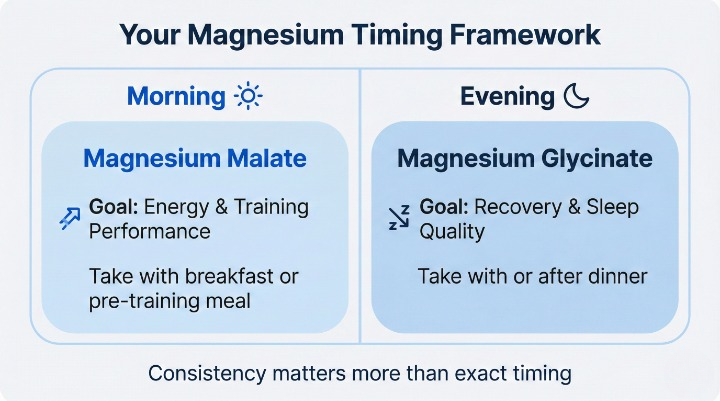
Big picture: for muscle growth and recovery, malate by day + (optionally) glycinate at night is a very reasonable framework.
When to Take Magnesium for Muscle Growth & Recovery
Timing matters less than total daily intake and consistency, but you can tilt the effects depending on your goal.
For Performance & Training Energy
If your main goal is energy and performance in the gym:
Take magnesium (especially malate) with breakfast or a pre-training meal.
Pairing it with carbs, protein, and sodium/potassium helps support overall electrolyte balance and ATP production.
For Recovery and Sleep
If your focus is post-workout recovery or sleep quality:
Take magnesium in the evening, ideally with or after dinner.
Glycinate is particularly useful here because it supports a calmer nervous system without acting like a sedative.
How It Fits with Your Training Split
High-volume or high-intensity days increase magnesium demand. Things to consider:
On heavy training days, make sure your total intake (food + supplements) is closer to the upper end of your target range.
If you’re on a GLP-1 weight-loss protocol, lower food volume can mean lower magnesium intake from diet, increasing the importance of a reliable supplemental baseline.
For most people, the simplest routine is:
Morning: Building Blocks with magnesium malate for training and metabolic support
Evening (if needed): A small dose of glycinate to assist with sleep and late-day cramping
How Much Magnesium You Need for Muscle Support
Recommended Intake vs Performance Intake
Official RDAs for adults:
Men: ~400–420 mg/day
Women: ~310–320 mg/day
Those numbers are designed to prevent clear deficiency in the average person—not to cover intense training, sweat loss, or chronic stress.
Active individuals often end up in the 400–500 mg/day total range (diet + supplements), depending on:
Body size
Training load
Diet quality (especially intake of leafy greens, nuts, seeds, and whole grains)
A key nuance: the tolerable upper intake level (UL) for supplemental magnesium from non-food sources is 350 mg/day for adults, mainly to avoid GI side effects like diarrhea. Food-derived magnesium doesn’t count toward this limit.
That’s why Building Blocks includes 200 mg of highly bioavailable magnesium malate—enough to meaningfully support performance while leaving room for additional magnesium from food or, when appropriate, a targeted evening supplement under clinician guidance.
Signs You May Need More Magnesium
These symptoms are nonspecific—they can come from many causes—but often show up when magnesium is low:
Frequent or severe muscle cramps and twitches
Unusual fatigue or poor workout recovery
Restless sleep or difficulty winding down
Irritability, “tired but wired” feeling
Higher blood pressure or metabolic issues alongside other risk factors
None of these diagnose magnesium deficiency on their own. If you’re noticing patterns like this—particularly in the context of hard training—it’s worth speaking with a healthcare professional about your diet, labs, and whether magnesium optimization makes sense for you.
Why Maximus Uses Magnesium Malate in Building Blocks
We didn’t choose magnesium malate for Building Blocks because it’s trendy—we chose it because it makes the most sense for performance medicine.
Bioavailability: Malate is an organic salt with better absorption than oxide and less GI upset than high-dose citrate.
Energy synergy: Malic acid feeds into the Krebs cycle, supporting mitochondrial ATP production during and after training.
Daily usability: Most people tolerate 200 mg of magnesium malate extremely well, even when training hard or using GLP-1 or testosterone protocols.
In other words, it behaves like an athlete-friendly base mineral, not just a box-checking ingredient.
Building Blocks is engineered to be the foundational multivitamin for Maximus clients—supporting testosterone production, metabolic health, and recovery. Magnesium malate sits at the heart of that stack so that your muscles, mitochondria, and nervous system have what they need when you ask more of them in training.
Safety, Side Effects & When to Talk to a Clinician
Magnesium is generally safe for healthy adults when used within recommended ranges, but a few cautions matter:
GI upset (loose stools, cramping, nausea) is the most common side effect, especially at higher doses or with oxide/citrate-heavy products.
People with kidney disease or significant renal impairment can’t clear magnesium efficiently and should not supplement without close medical supervision.
Magnesium can interact with some medications, including certain antibiotics and osteoporosis drugs; timing and dosing may need adjustment.
Because this is performance medicine, not DIY biohacking, it’s smart to loop in your clinician—especially if you’re:
On prescription medications
Living with chronic conditions
Considering doses above the standard 350 mg/day supplemental UL
FAQs
Does magnesium actually help build muscle?
Magnesium doesn’t replace progressive overload, adequate protein, or testosterone—but it enables the underlying processes: it supports mTOR signaling, stabilizes the ribosomes that synthesize new proteins, and participates in healthy testosterone biology and energy production. In people who are low or borderline, correcting magnesium can make training feel more productive and recovery smoother.
Which magnesium is best for muscle recovery?
For most lifters and athletes, magnesium malate is a strong primary choice because it’s well absorbed and supports ATP production, making it ideal for daytime energy and post-training recovery. Magnesium glycinate is excellent at night when you want nervous-system calm and sleep quality. We generally avoid relying on oxide-based products for muscle recovery because they’re poorly absorbed and mainly act as laxatives.
Should I take magnesium before or after a workout?
If your priority is training energy, taking magnesium (especially malate) earlier in the day or with a pre-training meal is reasonable. If your priority is sleep and recovery, a dose in the evening—often as glycinate—makes more sense. The most important factor is consistent daily intake, not hitting a perfect “magic” window around your workout.
Can magnesium help with post-workout cramps?
Magnesium can help reduce cramp risk when low magnesium is part of the problem, because it regulates calcium channels and neuromuscular excitability. However, cramps can also be driven by factors like dehydration, sodium/potassium imbalance, or simply very hard training. Think of magnesium as one piece of a cramp-management strategy, not a guarantee.
How much magnesium should I take if I lift weights?
Most active adults do well somewhere in the 400–500 mg/day total range (food plus supplements), but the exact number depends on body size, training volume, diet, and medical context. A common pattern is: 200 mg/day from a high-quality supplement like Building Blocks plus magnesium-rich foods, with adjustments made alongside a clinician if symptoms or labs suggest you need more.