Magnesium for Anxiety & Stress: What the Science Actually Says
Key Takeaways
Magnesium may modestly support stress resilience and mild anxiety, especially if your intake is low—think “foundation,” not a miracle cure.
The most plausible mechanisms involve NMDA (excitatory) regulation, GABA (calming) signaling, and stress-axis (HPA/cortisol) balance.
For most people, magnesium glycinate is the best first choice for anxiety + sleep support; magnesium malate is a strong daytime foundation for high performers (and the form in Building Blocks).
A smart approach is to cover your baseline daily magnesium, then target timing: evening dosing for nighttime rumination and sleep, or split dosing for all-day stress support.
Magnesium is not a replacement for therapy or prescription treatment—if anxiety is severe, worsening, or paired with panic, depression, or safety concerns, talk to a clinician.
Why People Are Turning to Magnesium for Anxiety
You don’t have to be “clinically anxious” to feel like your nervous system is running hot.
A lot of high performers live in a constant loop: heavy workload, constant inputs, irregular sleep, late caffeine, hard training (or not enough movement at all). The result can look like:
Racing thoughts at night
Muscle tension you can’t quite shake
Irritability, low frustration tolerance
A sense of being “tired but wired”
In that situation, it makes sense to look for something safer and more foundational than sedatives—and magnesium is one of the first supplements people try.
Here’s the honest answer: magnesium can help some people with stress and mild anxiety, especially if they’re not getting enough from diet. But it won’t replace therapy or medication for more serious anxiety disorders.
Think of magnesium like this: a biochemical foundation for a calmer nervous system, layered underneath habits, therapy/coaching, and (when needed) prescription care.
This doesn’t require a neuroscience degree. The simplest way to understand magnesium and anxiety is to think in terms of “volume knobs” in the brain: excitatory signals, calming signals, and the stress response.
Magnesium, Excitatory Signals & NMDA Receptors
NMDA receptors are one of the brain’s major “on switches.” They’re important for learning and memory—but when they’re overactive, the system can feel too loud:
rumination
sensory sensitivity
mental overdrive
trouble winding down
Magnesium acts like a natural gatekeeper at NMDA receptors. When magnesium levels are adequate, it helps prevent excessive NMDA activation. When magnesium is low—especially under chronic stress—the gate comes off more easily, and the brain can feel more “amped.”
Magnesium, GABA & Feeling Calm
GABA is the brain’s primary calming neurotransmitter—your internal brake pedal.
Magnesium appears to modulate GABAergic activity and support a more parasympathetic (“rest-and-digest”) state. That’s one reason many people notice magnesium most at night: it can make it easier to “downshift,” especially if their baseline stress is high.
The HPA Axis, Cortisol & Stress Resilience
The HPA axis (hypothalamus–pituitary–adrenal axis) governs your hormonal stress response. Cortisol isn’t “bad”—it’s what helps you wake up, train, and perform. The issue is when your stress system is chronically activated and never fully powers down.
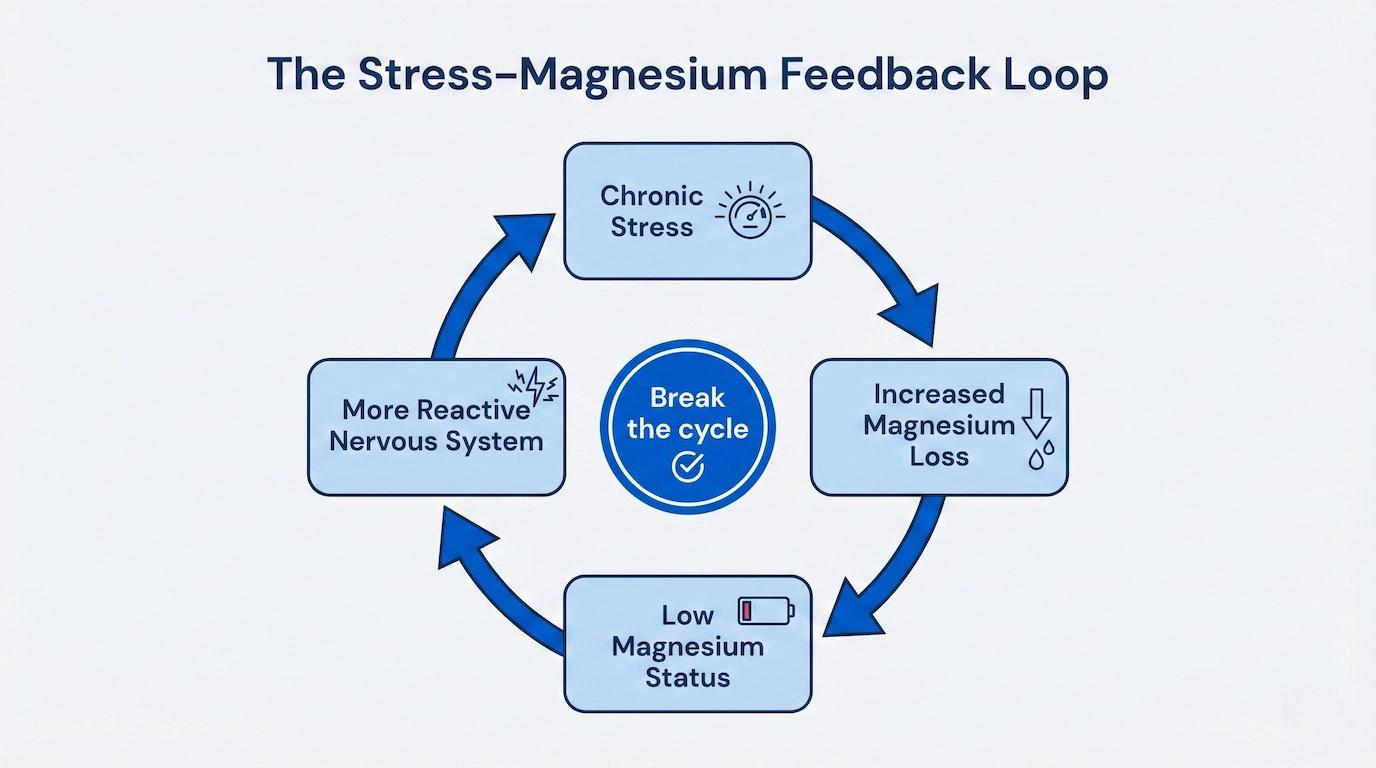
Magnesium and stress create a feedback loop:
stress increases magnesium loss (urine/sweat)
low magnesium can make the nervous system more reactive, which can increase perceived stress
This is why we frame magnesium as stress resilience, not “stress removal.” Life still has stressors. Magnesium helps your system handle them with less spillover.
What the Research Actually Shows on Magnesium & Anxiety
Let’s be transparent: the magnesium–anxiety literature is mixed, but there are signals worth paying attention to.
Some randomized trials and reviews suggest magnesium may reduce subjective stress or anxiety symptoms in certain populations, especially where deficiency or high stress is likely.
The methodology varies across studies (different forms, doses, durations, and outcome measures), and effect sizes are often modest.
So we set a realistic expectation:
If your anxiety is 8/10, magnesium alone won’t bring it to 0/10. But if you’re living around 4–6/10—persistent stress, restless sleep, tension, rumination—and your magnesium intake is low, getting to optimal levels can make a noticeable difference, especially paired with sleep, training, and therapy/coaching.
Situations where magnesium seems particularly relevant:
general stress and subclinical anxiety
sleep-related anxiety or nighttime rumination
PMS/PMDD-related mood symptoms (important for women)
The credibility move here isn’t overpromising—it’s acknowledging magnesium as a low-risk lever that can reduce friction in a bigger plan.
Best Types of Magnesium for Anxiety & Stress
Not all magnesium is created equal. The form you choose affects absorption, GI tolerance, and whether it feels better for daytime foundation vs nighttime calm.
Magnesium Glycinate – The Anxiety/Sleep Specialist
If your main goal is “calm the system,” magnesium glycinate is usually first-line.
Why it’s favored:
It’s a chelated form that’s typically well absorbed and gentle on the gut.
It’s bound to glycine, an amino acid with calming properties.
It pairs especially well with nighttime rumination, sleep onset issues, and muscle tension.
It’s also the form many clinicians prefer when anxiety and sleep are the main targets.
Magnesium malate is a strong daily driver for people who want broad support: energy, training, metabolic health, and a more stable stress response.
It’s magnesium bound to malic acid, a Krebs-cycle intermediate involved in ATP production.
It’s generally well tolerated at effective doses.
It supports overall magnesium repletion, which is the foundation for calmer signaling even if the form isn’t “sleep-branded.”
This is also why Maximus uses magnesium malate in Building Blocks—it’s a foundational form that makes sense for active people and those on testosterone or GLP-1 protocols.
Other Forms in Brief
Threonate: brain-targeting potential; limited direct anxiety data; often expensive and not ideal as a primary repletion strategy.
Citrate: useful for constipation, but more likely to cause GI side effects; not a first-line anxiety form.
Oxide: poorly absorbed; mostly a laxative; generally avoid as your main magnesium if your goal is nervous-system support.
This section should be practical, not prescriptive. Your best dose depends on diet, training, stress, and what you’re already taking.
Typical Dosing Ranges
Most adults aim to meet daily magnesium needs through food + supplements. The official RDAs are roughly:
men: ~400–420 mg/day
women: ~310–320 mg/day
Many people already fall short, especially with modern diets.
Two key points:
Higher supplemental doses often cause GI issues first, especially with citrate/oxide.
The tolerable upper intake level (UL) for magnesium from supplements (non-food sources) is 350 mg/day, set mainly to limit diarrhea; food magnesium doesn’t count toward that.
Building Blocks provides a foundational daily dose of magnesium malate. Some people then add a separate glycinate dose at night, ideally with clinician guidance, if anxiety/sleep symptoms are a priority.
Best Time to Take Magnesium for Anxiety
Match timing to your symptom pattern:
Nighttime rumination / sleep onset anxiety: evening dosing, ~1–2 hours before bed (glycinate is a common choice).
All-day stress / irritability: split dosing (morning + evening) can smooth coverage if tolerated.
Training-heavy schedule: keep malate earlier in the day (especially if you notice it feels energizing).
Also: magnesium can interfere with absorption of some medications (like certain antibiotics and thyroid meds) if taken too close together. If you’re on prescriptions, your clinician can help you time it safely.
Longer-term (2–4+ weeks): more stable mood, better sleep continuity, improved resilience—especially if you were low to begin with.
If you feel nothing after a few weeks, that doesn’t mean magnesium is useless—it may mean magnesium wasn’t your bottleneck (or the form/dose/timing wasn’t a match).
Safety, Side Effects & When Magnesium Isn’t Enough
Magnesium is generally safe for healthy adults when used within reasonable ranges, but there are real guardrails.
Common side effects:
loose stools / diarrhea
GI cramping or nausea
How to reduce that:
take with food
choose more tolerable forms (glycinate/malate)
lower the dose and titrate up slowly
People who should be cautious:
those with kidney disease or impaired renal function (risk of magnesium accumulation)
people on medications that affect electrolytes or absorption (diuretics, certain antibiotics, osteoporosis meds, thyroid meds)
Magnesium is also not enough when symptoms are severe. If you have:
panic attacks
severe depression
suicidal thoughts
rapidly worsening anxiety
inability to function day-to-day
…please seek professional help promptly. Supplements are not an appropriate substitute.
Magnesium can be supportive, but it’s not a replacement for therapy, CBT-I, psychiatric care, or prescribed medication when those are indicated.
How Magnesium Fits Into a Bigger Anxiety & Stress Plan
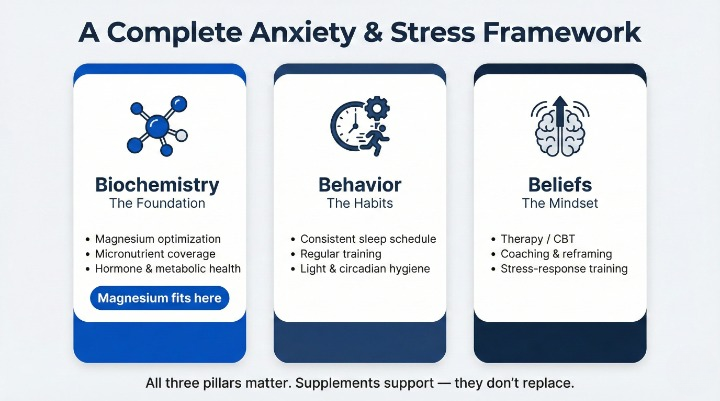
The best framework is: biochemistry + behavior + beliefs.
Magnesium supports the “biochemistry” layer, but you still need the other two.
Here’s how this fits together for high performers:
Sleep and circadian rhythm: consistent wake time, morning light, reduced evening light, and a real wind-down routine.
Training: regular resistance training + low-intensity cardio improves baseline anxiety for many people, likely via autonomic balance and stress-hormone regulation.
Therapy/coaching: CBT tools, exposure work, and reframing reduce the cognitive load that keeps anxiety running.
Hormone and metabolic optimization: poor sleep, insulin resistance, and hormonal dysregulation can amplify stress reactivity.
This is where Building Blocks fits: it ensures micronutrient gaps (magnesium included) aren’t quietly limiting your nervous system while you do the higher-level work.
A subtle but important bridge: Building Blocks also includes nutrients involved in mood pathways (like B vitamins), which we’ll cover more deeply in the upcoming B12 cluster.
Where Oxytocin Calming Cream May Fit (When Stress Is the Bottleneck)
For some high-performing adults, the issue isn’t “clinical anxiety”—it’s chronic stress and difficulty downshifting, especially at night.
In those cases, some Maximus clients explore additional support tools under clinician guidance, including our Oxytocin Calming Cream, a once-daily topical designed to support steady calm and improved sleep without next-day grogginess.
Magnesium and oxytocin aren’t “either/or.” A reasonable mental model is:
Oxytocin (topical): targeted support for calm and sleep regulation in the right candidates
If stress and sleep are affecting performance or quality of life, it’s worth discussing options with a Maximus clinician so you’re matching the tool to the real bottleneck.
FAQs
How long does it take for magnesium to help anxiety?
Some people notice subtle calming or less muscle tension within a few days, especially with nighttime dosing. More meaningful changes in sleep continuity and stress resilience often take 2–4 weeks of consistent use, particularly if you were low on magnesium to begin with.
Can I take magnesium with my anxiety medication or SSRI?
Often yes, but it depends on the medication and timing. Magnesium can interfere with absorption of certain drugs (including some antibiotics and thyroid medications) if taken too close together. If you’re on prescriptions, ask your clinician about safe spacing and whether magnesium is appropriate for you.
Can magnesium replace my prescription for anxiety?
No. Magnesium may support mild anxiety and stress resilience, but it is not a replacement for therapy or prescribed treatment for anxiety disorders. If your anxiety is severe, worsening, or impairing daily function, work with a licensed clinician.
Is it better to take magnesium for anxiety in the morning or at night?
If your anxiety shows up as nighttime rumination or trouble falling asleep, evening dosing (often glycinate) is typically best. If your stress is more all-day irritability or tension, a split dose (morning + evening) may help—assuming your gut tolerates it.
Can I take magnesium every day long-term?
Many people can take magnesium daily within reasonable total intake ranges, especially when using well-tolerated forms and accounting for magnesium already in products like multivitamins. Long-term use should be reviewed with a clinician if you have kidney disease, take medications, or are considering higher supplemental doses.